


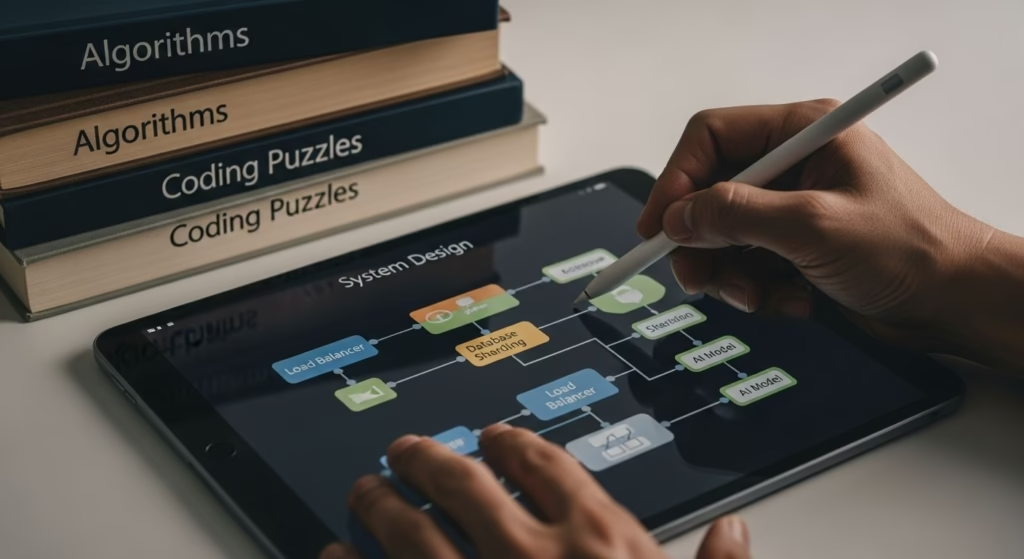
If you search “how to pass the Google interview” on YouTube right now, you will find thousands of videos. Some of them have millions of views. They feature smart, well-meaning engineers standing in front of whiteboards, teaching you how to invert a binary tree or calculate the number of golf balls that fit inside a Boeing 747.
Here is the hard truth: Most of that advice is expiring.
If you are preparing for the Google interview process in 2025 using a playbook from 2020, you are preparing for a test that no longer exists. The landscape of technology has shifted tectonically in the last five years. AI has changed how we code. Hybrid work has changed how we collaborate. And naturally, these things have changed who (and how) we hire.
We are writing this because we see too many brilliant candidates fail. Not because they aren’t smart, but because they are optimizing for the wrong metrics. They are memorizing algorithms when they should be demonstrating adaptability. They are training to be “human encyclopedias” in an era where AI is the encyclopedia.
So, let’s tear up the old study guide. Here is exactly how the Google interview process has evolved, and the three specific skills our recruiters are prioritizing over rote memorization in 2025.
The Death of the “Brain Teaser” (For Real This Time)
Let’s get this out of the way: We don’t care about the golf balls. We haven’t cared about the golf balls for a long time, but the myth persists.
In 2020, the Google interview process was heavily indexed on algorithmic fluency. We asked you to solve complex puzzles on a whiteboard because, at the time, that was a decent proxy for raw cognitive processing power. But in 2025, pure algorithmic memorization is a commodity.
If you can recite the solution to “Dijkstra’s Algorithm” from memory, that’s cool. But Gemini can do that in 0.4 seconds. If your primary skill is memorization, you are competing against a machine that will always beat you.
What Changed?
We have shifted from “Puzzle Solving” to “Problem Finding.”
In a modern Google interview, you are less likely to get a question with a single, perfect mathematical answer. You are more likely to get a question that is intentionally vague.
Old Question: “Write a function to sort this list of integers.”
New Question: “Design a sorting system for a streaming service where user preferences change in real-time. How do you handle latency vs. accuracy?”
See the difference? The first checks if you studied. The second checks if you can think. We are looking for candidates who ask clarifying questions. We want to see you struggle with trade-offs. If you immediately start writing code without asking “What are the constraints?”, you are failing the 2025 interview.
Shift #1: The “Open Book” Era (AI Collaboration)
This is the biggest change, and the one candidates are most confused about. Is it “cheating” to use AI concepts in an interview?
No. In fact, ignoring AI might be a red flag.
We build AI. We use AI. We expect our engineers to leverage AI. In certain technical rounds of the Google interview process, we are now explicitly looking for “AI Literacy.” This doesn’t mean you need to be a Machine Learning researcher. It means you need to know when to delegate to the machine.
The “Copilot” Test:
We might ask you to debug a block of code. In 2020, you had to find the syntax error with your eyes. In 2025, we are more interested in your process. Can you explain why the bug occurred? Can you explain how you would generate a test case to ensure it never happens again?
We value engineers who treat AI as a force multiplier. If you are stuck on syntax, it’s okay to say, “I would typically reference documentation or use an AI assistant to get the boilerplate for this API, so I can focus on the logic.” That shows maturity. Pretending you know everything by heart shows hubris.
Shift #2: System Design is No Longer Just for Seniors
Historically, “System Design” interviews (where you design Twitter or YouTube on a whiteboard) were reserved for L5 (Senior) candidates and above. Juniors just had to code.
That wall is crumbling. Because AI tools handle so much of the implementation detail now, every engineer is effectively becoming an architect sooner in their career. As a result, the Google interview process is introducing system design concepts much earlier.
Even for early-career roles, we expect you to understand:
- Scalability: What happens if 1 million people use your feature at once?
- Data Flow: Where does the data live? Is it consistent?
- Trade-offs: Why did you choose a SQL database over NoSQL? (Hint: “Because it’s the only one I know” is a bad answer).
How to Prepare: Stop spending 100% of your time on LeetCode. Shift 40% of your prep time to reading engineering blogs. Read the whitepapers on how Google Spanner works. Understand the difference between TCP and UDP. We hire engineers who see the big picture.
Shift #3: “Googleyness” in a Hybrid World
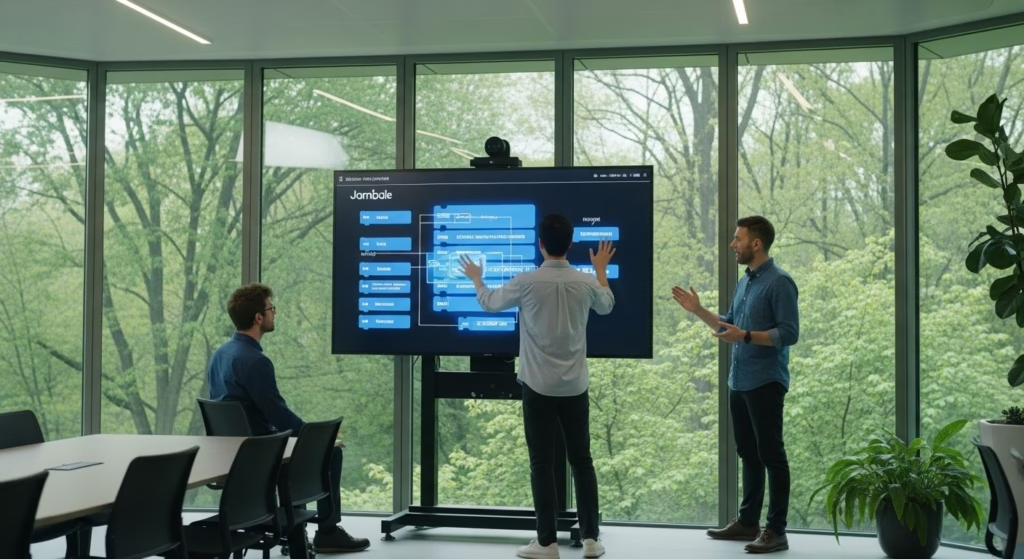
“Googleyness” is a term we use a lot. It’s easy to roll your eyes at it, but it’s actually a strict rubric we use to measure cultural addition. And the definition of Googleyness has evolved with the Google interview process.
In 2020, we looked for “intellectual humility.” We still do. But in 2025, we are fiercely hunting for “Ambiguity Tolerance.”
The tech world is moving faster than ever. Priorities shift. Projects get reorganized. New models release every week. We need employees who don’t crumble when the roadmap changes.
The Behavioral Interview Update:
Expect questions like: “Tell me about a time you had to make a decision with incomplete data.” or “Tell me about a time a project requirement changed halfway through.”
If your answer is “I waited for my manager to tell me what to do,” you likely won’t get the offer. We want to hear how you navigated the fog, how you communicated with your team, and how you kept moving forward. In a hybrid world, you need to be a self-starter.
The Resume Reset: Impact > Responsibilities
Before you even get to the Google interview process, you have to pass the resume screen. This is where 90% of candidates disqualify themselves.
In 2025, our recruiters are using AI tools to help scan resumes, but human hiring committees make the final call. Both the AI and the humans are looking for one thing: Impact.
Most resumes look like a job description:
“Responsible for writing Java code for the backend API. Attended daily stand-ups. Managed a team of 3 interns.”
This tells us what you did, but not how well you did it. In a competitive market, this is invisible.
Here is what a 2025-ready resume bullet looks like:
“Refactored the backend payment API using Go, reducing server latency by 40% and saving $20k/month in cloud compute costs. Led 3 interns to deliver the project 2 weeks ahead of schedule.”
See the difference? Metrics. Outcomes. Value. If you can’t quantify your work, dig deeper. Did you fix bugs? How many? Did you improve UI? Did engagement go up? We hire people who move the needle, not just people who fill a seat.
How to Actually Prepare (The 2025 Study Guide)
Okay, so the old way is dead. How do you prepare for the new Google interview process? Here is your checklist:
- Practice “Talking Out Loud”: The silent genius fails the interview. When you practice coding, narrate your thought process. “I’m choosing a Hash Map here because lookup speed is critical…” We need to hear your engineering intuition.
- Mock Interviews with Constraints: Don’t just solve the problem. Ask a friend to change the constraints halfway through. “Actually, assume the memory is limited to 1GB.” Can you pivot? That is the test.
- Learn the “Why”: Don’t just learn how to use a library (React, TensorFlow, Kubernetes). Learn why it exists and what problems it solves. We will ask you about the underlying principles.
- Prepare Your “Failure” Story: You will be asked about a time you failed. Have a genuine story ready. Don’t do the “humble brag” (“I worked too hard!”). Tell us about a bug you shipped, a deadline you missed, and most importantly, what you learned. We hire humans, not robots.

Conclusion: It’s Harder, But Fairer
You might be reading this thinking, “Great, so the interview is even harder now?”
In some ways, yes. The bar for shallow technical knowledge has been raised because AI can do the shallow work. But in many ways, the Google interview process is fairer than it has ever been.
We are less interested in whether you memorized a textbook from 1999. We are more interested in who you are as a collaborator, a thinker, and a builder. We are looking for the people who can take the powerful tools of 2025 and build the future.
So, close the logic puzzle book. Open a system design paper. Start building something messy. And come talk to us.
Ready to apply? Explore open roles on the Google Careers site and see where your skills fit.
FAQ: The 2025 Google Interview
Do I still need to know Data Structures and Algorithms (DSA)?
Yes, absolutely. DSA is the foundation of computer science. However, the interview focus has shifted from rote memorization of obscure algorithms to the practical application of these structures to solve ambiguous problems. You need to know when to use them, not just how to write them from scratch.
Can I use ChatGPT or Gemini during the Google interview?
Generally, no, unless the interviewer explicitly sets up a specific ‘AI-assisted’ exercise. The goal is to evaluate your problem-solving capabilities. However, mentioning how you would use these tools in a real-world scenario is often encouraged as part of your thought process explanation.
What is the ‘Googleyness’ interview?
This is a specific behavioral round dedicated to assessing cultural add. We look for traits like comfort with ambiguity, collaborative nature, bias for action, and prioritizing the user. It is graded just as strictly as the coding rounds.
How long is the hiring process in 2025?
We have worked hard to streamline our velocity. While it varies by role, most candidates go through a recruiter screen, a technical screen, and a virtual onsite loop (3-4 interviews) within 3-5 weeks.
Does Google hire self-taught engineers?
Yes. We removed the degree requirement for many roles years ago. If you can pass the technical bar and demonstrate the right problem-solving skills and experience (via portfolio or past work), we do not care if you learned it at Stanford or on YouTube.