


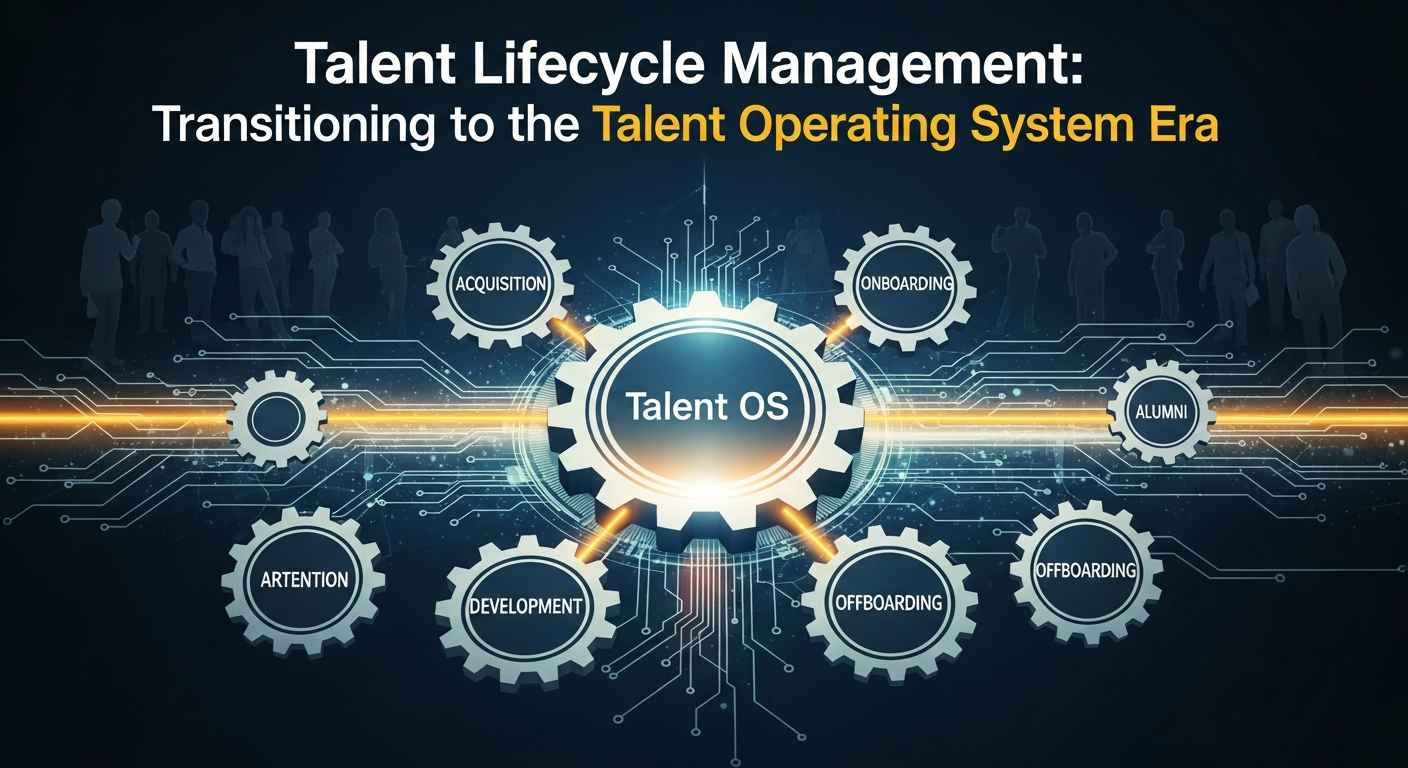
Talent Lifecycle Management: Transitioning to the Talent Operating System Era
The evolution of Talent Acquisition (TA) from a reactive, administrative function to a proactive, strategic powerhouse is characterized by the emergence of Talent Lifecycle Management (TLM). This paradigm shift marks the transition from fragmented “point-solution” Applicant Tracking Systems (ATS) and legacy CRMs toward integrated “Talent Operating Systems.” These systems provide a comprehensive framework for managing the entire employee journey, from the initial point of discovery to long-term alumni engagement. As we witness the Talent Acquisition Evolution: From Keywords to Cognitive AI, organizations are realizing that hiring is no longer a series of isolated events but a continuous ecosystem of human capital.
In the previous decade, the recruitment function was often relegated to a transactional role—filling seats as they became vacant. However, the volatile labor markets of the 2020s, characterized by the “Great Reshuffle” and the subsequent “quiet quitting” and “quiet hiring” phenomena, have forced a re-evaluation of how organizations interact with human capital. The modern enterprise no longer views talent as a series of disconnected transactions but as a continuous lifecycle. This holistic view is the bedrock of Talent Lifecycle Management, a strategy that demands a robust technological infrastructure to succeed in an increasingly competitive global landscape.
The Structural Shift to Talent Operating Systems (TOS)
Traditional recruitment models prioritized “recruiting as a task”—a linear process triggered by a vacancy and concluded by a hire. Modern TLM, however, views talent as a dynamic lifecycle. The Talent Operating System (TOS), a term popularized by market leaders like Beamery, serves as a centralized “single source of truth” for all talent data. This infrastructure is specifically designed to break down the historical silos between external sourcing, internal mobility, and long-term talent development.
The move toward a TOS is driven by the digitalization of talent acquisition, where recruitment teams are increasingly acting as internal business consultants rather than just resume screeners. Centralizing data allows organizations to maintain “talent data hygiene,” ensuring that candidate interactions across years are logged, analyzed, and leveraged for future needs. For global enterprises, this architectural philosophy represents a shift away from “speed-to-hire” as the sole metric toward “long-term talent transformation.”
Beyond the System of Record
A Talent Operating System differs from a traditional ATS in its intent. While an ATS is a “system of record” designed for compliance and workflow management once a candidate applies, a TOS is a “system of engagement.” It is built to manage the relationship long before an application exists and long after the hiring manager closes the requisition. By treating every individual in the talent pool—whether they are a prospective lead, a current employee, or a former staff member—as a part of a single ecosystem, organizations can achieve a level of workforce agility that was previously impossible.
The limitations of the legacy ATS have become a bottleneck for innovation. In the past, data was trapped in static databases, often becoming obsolete within months of a candidate’s initial application. A TOS revitalizes this data through AI-driven enrichment, constantly updating profiles with new skills, social signals, and professional milestones. This ensures that the “talent bank” remains liquid and actionable at all times.
Comparative Analysis: Gem vs. Beamery
The selection between leading platforms often depends on an organization’s maturity, its hiring volume, and its specific definition of a “pipeline.” Both platforms aim to solve the fragmentation of the recruitment tech stack, but they approach the problem from different philosophical angles.
1. Beamery: The Holistic Operating System
Beamery is engineered for enterprise-grade, long-term talent strategy. Its infrastructure supports “Total Talent Management,” integrating internal employees with external candidates. It is positioned as a sophisticated lifecycle tool that handles high-level workforce planning and complex global compliance requirements. It is favored by organizations focusing on “Strategic Headcount Planning” and “Skill-Based Transformation.”
Beamery’s strength lies in its ability to act as the cognitive layer above the ATS. It uses advanced AI to map the skills of the entire workforce and the external market. This allows large-scale enterprises to see where their talent gaps are and whether those gaps should be filled by external hiring, internal upskilling, or the deployment of contingent labor. For a Fortune 500 company navigating a digital transformation, Beamery’s Talent Operating System provides the visibility required to move talent across borders and departments seamlessly.
2. Gem: The High-Efficiency Growth Engine
Conversely, Gem has historically been the preferred choice for high-growth technology firms and mid-market companies that prioritize “speed-to-lead” and seamless recruiter workflows. Gem’s design philosophy is centered on the recruiter experience. Its strength lies in its tight integration with existing ecosystems like Gmail, LinkedIn, and various ATS platforms.
Gem excels in automated outreach sequencing and visual pipeline management, making it the “gold standard” for teams requiring high-volume, high-quality sourcing and immediate candidate engagement. It addresses the “last mile” of recruitment—the actual interaction between the recruiter and the prospect. While Gem has expanded its CRM capabilities to include more lifecycle features, such as internal mobility and events management, it remains a tactical favorite for “outreach-heavy” teams that need to build pipelines quickly and maintain high conversion rates through personalized automation.
The choice between the two often comes down to the “Strategic vs. Tactical” balance. Beamery is a top-down strategic platform for workforce transformation, while Gem is a bottom-up efficiency tool designed to empower the individual recruiter to win the war for talent through superior engagement.
Predictive Pipeline Analytics and Quantifiable ROI
The professionalization of recruitment data has necessitated a shift from basic KPIs, such as “Time to Fill,” to “Predictive Pipeline Analytics.” This involves applying data science to recruitment to forecast future hiring needs and outcomes with mathematical precision. This data-centric approach is part of the broader focus on AI in Recruitment: Ethical Sourcing & Predictive Analytics, where numbers drive strategy rather than intuition.
Sourcing Attribution Modeling
Organizations are now utilizing multi-channel attribution to identify exactly which touchpoints lead to a hire. In the same way a marketing team tracks a customer’s journey from a social media ad to a purchase, TA teams track a candidate’s journey from a LinkedIn sequence to a specific event, or a referral. Gem’s visual pipeline analytics allow for granular tracking of “funnel stage leakage.” By identifying exactly where candidates are dropping out of the process, TA leaders can optimize conversion rates in real-time, rather than waiting for an end-of-quarter post-mortem.
Predictability and Velocity
Predictive analytics provide “Time-to-Fill” predictability and “Pipeline Velocity” metrics. This allows TA leaders to justify budgets for “nurture campaigns” that may not yield immediate results but significantly lower the long-term Cost-Per-Hire. If a TA leader can prove that a nurtured “silver medalist” (a candidate who was the second choice for a previous role) costs 50% less to hire and stays 20% longer than a cold lead, the ROI of the Talent Operating System becomes undeniable.
Executive Reporting and Strategic Alignment
Beamery’s reporting focuses on “Executive Insights,” linking talent data to broader business outcomes such as revenue per employee and global diversity progress. This elevates the recruiter’s role to a data-driven business partner. Instead of reporting on how many interviews were conducted, TA leaders can report on how the current talent pipeline supports the company’s three-year growth strategy. This shift is highlighted in Gartner’s latest HR trends and priorities, which emphasize the need for HR to become a more strategic, data-centric function.
The Skills-First Revolution and Human Capital Mapping
A foundational trend in 2025 is the transition from “role-based” hiring to “skills-first” talent architectures. This shift addresses the shrinking global labor market and the rapid obsolescence of technical skills by focusing on “skill adjacency”—identifying candidates who possess a significant portion of a required skill set and have the inherent potential to learn the rest.
AI-Augmented Skills Intelligence
Platforms like Beamery utilize “Skills Graph” technology to extract skills from resumes, GitHub profiles, and internal performance reviews. This creates a dynamic, living map of an organization’s human capital. Instead of searching for a “Software Engineer Level 4,” a recruiter might search for a specific combination of Python, cloud architecture, and leadership skills. This allows for a much broader and more creative search, uncovering talent that traditional keyword searches would miss.
Internal Mobility and the Power of Silver Medalists
A critical component of TLM is the “Internal Talent Marketplace.” Companies are increasingly looking inward to redeploy existing talent. This not only reduces recruitment costs but also significantly boosts employee retention. Furthermore, the concept of the “silver medalist” has been revitalized. These are high-performing candidates who were qualified but not selected for a previous role. By maintaining these relationships within a CRM, companies can re-engage them the moment a matching role opens up, drastically reducing the time-to-hire.
Agile Talent Allocation
By mapping the organization’s “Skill Inventory,” leadership can more effectively allocate talent to high-priority projects. This is “Agile Talent Allocation.” If a company suddenly needs to pivot toward Generative AI, a skills-first architecture allows them to identify every employee with mathematical or data science backgrounds who could be upskilled, rather than competing in an over-heated external market for new hires.
Hyper-Personalization and Candidate Nurture Flows
In a hyper-competitive market, generic, templated outreach is no longer effective. Candidates, particularly those in high-demand fields like engineering or healthcare, are inundated with messages. “Hyper-personalization at scale” has become the baseline for engaging top-tier passive talent.
Automated Nurture Sequences
Gem’s core reputation is built on its “Sequencing” tool, which allows for automated, multi-channel follow-ups (email, SMS, LinkedIn) that maintain a high-touch, personal feel. The key is the “Nurture Gap”—the period between a candidate’s initial rejection of an offer and their eventual availability six to eighteen months later. Automated nurture flows keep the employer brand in front of the candidate with relevant content, ensuring that when they are ready to move, your company is their first thought.
Talent Communities and Branded Content
Beamery addresses engagement through segmented “Talent Communities.” These are not just mailing lists; they are digital hubs where prospective candidates receive automated, branded content tailored to their specific career interests. A DevOps engineer receives white papers on infrastructure, while a sales professional receives insights on market growth. This keeps the employer brand “top-of-mind” without manual recruiter effort, effectively moving candidates through the “awareness” and “consideration” stages of the recruitment funnel automatically.
Consumerization of Candidate Experience
The modern candidate journey is expected to mirror an e-commerce transaction: seamless, personalized, and mobile-friendly. Companies that leverage AI for personalized copywriting and sentiment analysis are seeing higher response rates and improved employer brand equity. The goal is to reduce “friction” at every stage of the lifecycle. If a candidate has to create a new login for every application, you have already lost them. Integrated Talent Operating Systems solve this by maintaining a single profile for the candidate that persists across all interactions.
Ethical AI, Governance, and Global Compliance
As AI-native platforms become standard in the TA tech stack, the institutionalization of “Ethical AI and Algorithmic Transparency” has become paramount. AI is no longer a “black box” feature; it is a core component that must be governed with precision.
Regulatory Landscapes and the EU AI Act
Organizations must now navigate complex regulations such as the EU AI Act and various local laws, such as New York City’s AI hiring legislation. These laws require “Auditable AI Hiring” practices and “Algorithmic Bias Mitigation” to ensure fair-match recruiting. Platforms like Beamery have invested heavily in compliance, providing tools that allow companies to audit their AI recommendations and ensure they are not inadvertently discriminating against protected groups.
DEI Transparency and Bias Mitigation
Modern CRMs now include comprehensive Diversity, Equity, and Inclusion (DEI) dashboards that track diversity at every funnel stage. This allows TA leaders to see if their sourcing is diverse, but more importantly, it shows if there is a bias in the interview or offer stage. If 50% of the initial pipeline is diverse, but only 10% of the final interviews are, the system flags a potential bias in the screening process. This level of transparency is essential for organizations that have made public commitments to diversity.
Data Sovereignty and Global Privacy
For global firms, compliance with GDPR and other data privacy laws is non-negotiable. The “right to be forgotten” is a technical challenge when candidate data is spread across multiple spreadsheets and outdated systems. A unified Talent Operating System provides automated workflows for data deletion and consent management, ensuring that the organization remains compliant across dozens of different jurisdictions simultaneously. This governance reduces legal risk while building trust with the candidate pool.
The Convergence of MarTech and HRTech
The most significant overarching trend in the evolution of Talent Acquisition is the application of Sales and Marketing (MarTech) principles to the recruitment process. This “MarTech-ification” treats candidates as “prospects” within a sophisticated sales funnel.
Lead Scoring for Talent
Similar to sales tools like Salesforce or HubSpot, modern recruitment CRMs use “Lead Scoring” to automatically flag candidates who show high intent. If a passive candidate visits the company’s “Engineering Culture” page multiple times and opens a recruitment newsletter, their lead score spikes. This notifies the recruiter to reach out immediately, as the candidate is likely “warm” and considering a change.
Recruitment Marketing Funnels
The focus has shifted from “filling vacancies” to “building communities.” Recruiters are beginning to act as content strategists, using rich media, employee stories, and “Inbound Recruiting” to build “Talent Brand Equity.” By the time a recruiter reaches out, the candidate should already have a positive perception of the company’s mission and culture. This reduces the friction of the initial outreach and increases the “reply rate,” which is one of the most critical metrics for sourcing efficiency.
Systems of Engagement vs. Systems of Record
The industry has identified a clear distinction between the ATS (a system of record) and the CRM/Operating System (a system of engagement). In the past, recruiters spent 80% of their time in the ATS doing administrative work. In the future, the ATS will exist quietly in the background as a compliance engine, while recruiters spend their time in the “System of Engagement,” focusing on relationship-building and strategic influence.
Strategic Workforce Transformation and the Future
The culmination of these trends leads to “Strategic Workforce Planning.” By combining predictive analytics, skills intelligence, and personalized engagement, organizations can move from reactive hiring to proactive talent acquisition. This involves three key pillars:
- Talent Ecosystem Mapping: Visualizing the entire talent landscape, both internal and external. This allows leadership to understand not just who is available to hire today, but where the talent they will need in two years is currently located.
- Workforce Transformation: Using AI-native platforms to transition from legacy hiring models to agile, skills-based architectures. This ensures that the workforce can adapt to technological disruptions without requiring massive layoffs and rehiring cycles.
- Recruitment Process Optimization: Leveraging AI to automate administrative tasks, such as interview scheduling and initial screening. This allows recruiters to focus on high-value human interaction, acting as “Business Consultants” who advise hiring managers on market reality and talent strategy.
The New Recruiter Profile
As systems become more intelligent, the role of the recruiter is being redefined. The recruiter of 2025 must be a hybrid of a data scientist, a marketing specialist, and a talent advisor. They must understand how to interpret pipeline analytics, craft compelling brand narratives, and navigate the ethical implications of AI-driven sourcing. Those who embrace the Talent Operating System will find themselves at the center of the organization’s growth strategy.
Conclusion: The Path Forward
The transition to Talent Lifecycle Management is not merely a technological upgrade but a fundamental shift in how organizations perceive, attract, and retain human capital. In 2025 and beyond, the competitive advantage lies with companies that treat their talent pipeline as a strategic, long-term asset managed through a unified, data-driven operating system.
Organizations must prioritize the integration of their tech stack to ensure a seamless flow of data. This means moving away from “Frankenstein” stacks of disconnected tools and toward a unified TOS that connects the ATS, the CRM, and internal talent marketplaces. Those who continue to rely on fragmented, reactive processes will find themselves unable to compete for the specialized skills required to thrive in the modern economy. The era of the Talent Operating System has arrived, and it is redefining the boundaries of what is possible in human capital management.