


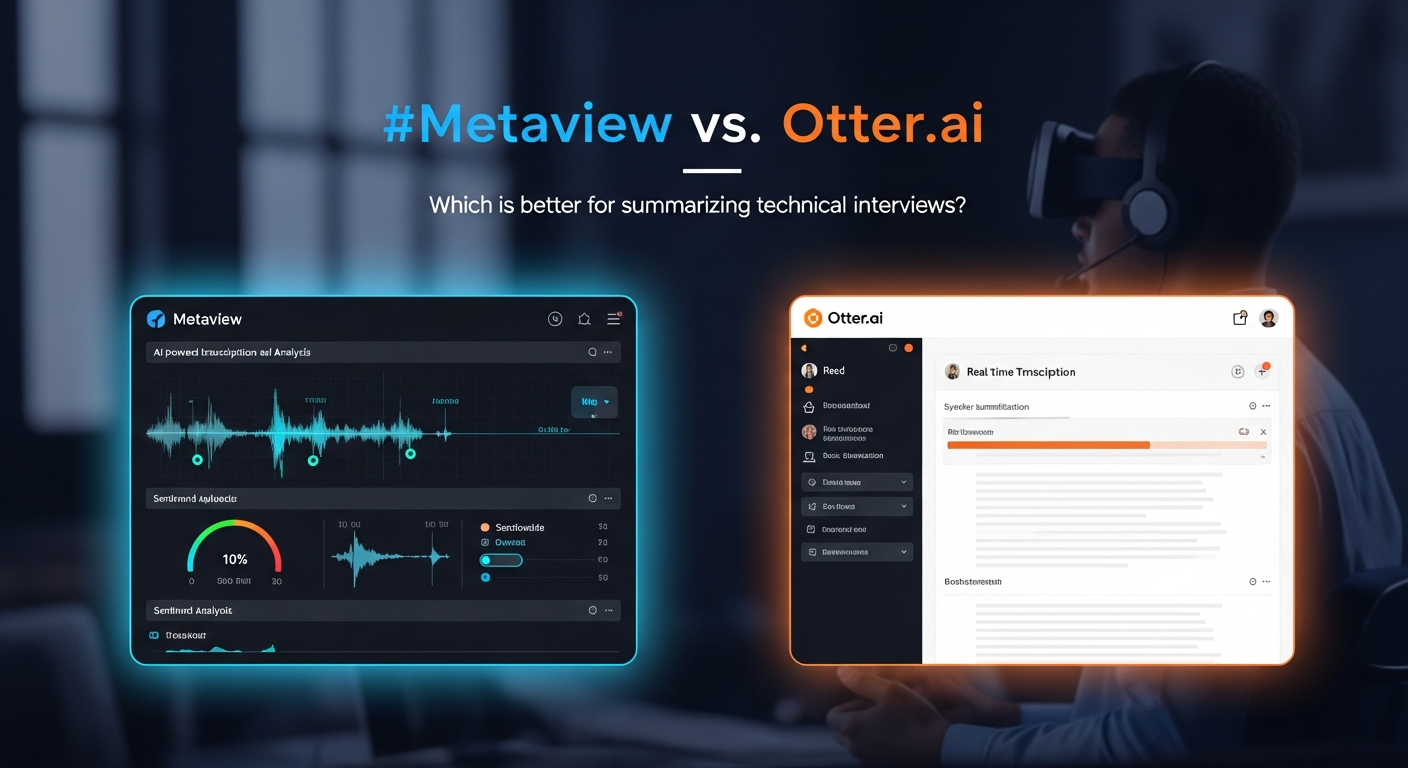
Metaview vs. Otter.ai: Which is better for summarizing technical interviews?
The technical interview is a high-stakes environment where every word matters. For engineering managers and recruiters, the challenge has always been a binary choice: focus entirely on the candidate’s problem-solving process and risk forgetting the nuances of their answers, or take meticulous notes and risk losing the human connection. As firms move from legacy ATS to AI-driven talent intelligence, the demand for automated summarization has skyrocketed.
The rise of generative AI has introduced a third option: automated interview intelligence. However, as the market matures, a clear divide has emerged between “Horizontal AI” tools—designed for general-purpose transcription across all industries—and “Vertical AI” tools—engineered specifically for the recruitment lifecycle.
In this deep dive, we compare Metaview, the leading vertical AI for recruiting, against Otter.ai, the titan of general-purpose meeting transcription, to determine which platform truly serves the needs of high-growth technical hiring teams.
The Fundamental Divide: Horizontal vs. Vertical AI
To understand the difference between Metaview and Otter.ai, one must first understand the architectural philosophy behind each. The decision between these tools often mirrors the broader talent acquisition evolution from simple keyword matching to cognitive intelligence.
Horizontal AI platforms like Otter.ai are designed for broad utility. Their goal is to be the “recording layer” for every meeting in a company, from marketing brainstorms to board meetings. They excel at high-fidelity speech-to-text and general summarization. They treat every conversation as a “meeting.”
Vertical AI platforms like Metaview are built exclusively for a single domain—in this case, recruitment. Metaview doesn’t treat an interview as a “meeting”; it treats it as a “structured evaluation.” Its models are trained not just to understand English, but to understand the specific mechanics of a technical interview, the structure of a coding challenge, and the nuances of candidate signaling.


Metaview: Specialized Vertical AI for Technical Hiring
Metaview has rapidly become the gold standard for tech firms like Brex, Quora, and Hellofresh. Its primary differentiator is its deep awareness of the recruitment tech stack and the specific linguistic patterns of engineering discussions.
1. Recruitment-Specific Summaries
Unlike a general summary that might list “topics discussed,” Metaview generates structured notes that align with hiring scorecards. If an interviewer is evaluating a candidate on “System Design” or “Concurrency in Go,” Metaview identifies these segments. It categorizes notes into “Technical Proficiency,” “Culture Fit,” and “Problem-Solving Approach,” allowing hiring managers to skim the highlights of a 60-minute technical deep-dive in seconds.
2. Technical Jargon and Contextual Awareness
General transcription tools often struggle with technical nomenclature. When a candidate discusses “Kubernetes pods,” “React hooks,” or “O(log n) complexity,” a general tool might misspell or miscontextualize the terms. Metaview’s underlying models are fine-tuned on hundreds of thousands of technical interviews.
It understands the “Why” behind a technical decision. While a horizontal AI might summarize a coding session as “The candidate wrote a loop to solve the problem,” Metaview’s vertical AI captures the nuance: “The candidate initially proposed a brute-force O(n²) solution but optimized it to O(n log n) after discussing memory constraints and edge cases.”
3. Native ATS Integration
One of the most significant pain points in recruiting is “administrative drag”—the time spent copying notes from a document into an Applicant Tracking System (ATS). Metaview solves this through deep integration with tools like Greenhouse, Lever, and Ashby. It automatically pushes the interview summary, key signals, and even the full transcript directly into the candidate’s profile in the ATS. This eliminates manual data entry and ensures that the hiring record is always up to date.
4. Interview Intelligence and Quality Control
Metaview provides a layer of “Interview Intelligence” that Otter cannot match. It offers analytics on:
* Talk-time Ratios: Is the interviewer talking more than the candidate?
* Shadowing: It provides a structured way for new interviewers to “shadow” senior staff by reviewing transcripts and summaries of top-tier interviews.
* Consistency: It helps ensure that different interview panels are asking consistent questions across the hiring pipeline.

Otter.ai: Horizontal Utility and Productivity
Otter.ai remains one of the most popular transcription tools in the world. For a technical recruiter on a budget, it offers several key benefits, though they are primarily focused on general productivity rather than recruitment intelligence. As noted in various top AI recruitment tools for 2025, horizontal tools serve as a gateway for smaller teams.
1. Real-time Collaborative Note-taking
Otter’s standout feature is its live transcript. During a call, multiple team members can highlight text, add comments, and insert images into the transcript in real-time. This is particularly useful for panel interviews where one person is leading the conversation and another is acting as the scribe.
2. Cost Efficiency
Because Otter is a general-purpose tool, it is often more affordable on a per-seat basis than specialized recruitment software. For a small startup that only conducts a few interviews a month and needs a tool that can also be used for internal team meetings and sales calls, Otter provides a high level of versatility.
3. Broad Application
Otter is a “one-stop-shop” for company communication. You can use it for your Monday morning stand-up, a client briefing, and a candidate interview. This reduces the number of tools a company needs to manage, providing a unified search interface for all recorded company conversations.

Head-to-Head: Technical Interview Summarization Performance
In technical hiring, the quality of a summary is measured by its ability to capture “The Signal” amidst “The Noise.” Let’s look at how both tools handle the common components of a technical interview.
The System Design Round
In a system design interview, candidates often white-board complex architectures.
* Otter.ai will provide a linear transcript. It may capture that the candidate talked about “Load Balancers” and “Database Sharding,” but the summary will likely be a chronological list of topics without identifying architectural trade-offs.
* Metaview recognizes this as a System Design module. Its summary will highlight the candidate’s specific trade-off decisions, such as why they chose NoSQL over SQL for a specific use case, and how they handled the CAP theorem constraints.
The Coding Challenge
During live coding, the conversation is often fragmented as the candidate thinks aloud.
* Otter.ai struggles to make sense of fragmented speech combined with the sound of typing. The resulting transcript can be cluttered and difficult to parse.
* Metaview is designed to understand the rhythm of a coding interview. It filters out the “noise” and focuses on the logic explained by the candidate, summarizing their algorithmic approach and their ability to respond to hints.
The Behavioral Round
- Otter.ai provides a good general summary of what was said.
- Metaview uses its recruitment-specific logic to flag “Soft Skill Signals.” It can categorize responses into “Leadership,” “Conflict Resolution,” or “Ownership,” directly mapping these to the company’s core values.
The Productivity Impact: By the Numbers
The adoption of AI in recruiting isn’t just about “cool tech”; it’s about Return on Investment (ROI). Research into technical interview software ratings reveals a stark difference in productivity gains.
- Time Savings: Users of specialized vertical AI report saving an average of 20 to 40 minutes of post-interview write-up time per candidate.
- Recall Bias: Humans often miss 20-30% of critical information when multitasking between listening and writing. Automated tools eliminate this bias.
- Candidate Experience: By removing the need for frantic typing, interviewers can maintain eye contact, improving the candidate’s perception of the company.

Integration, Security, and Compliance
For technical organizations, data security is non-negotiable. Both Metaview and Otter.ai offer robust security features, but they approach compliance from different angles.
Otter.ai is SOC 2 Type II compliant and provides standard encryption. However, because it is a general tool, the responsibility of ensuring that sensitive candidate data is handled correctly often falls on the user.
Metaview is built with the specific sensitivities of HR and Recruitment in mind. This includes:
* Automated Consent: Metaview handles the “recording consent” flow automatically, ensuring candidates give permission before recording starts—a key requirement for GDPR and CCPA.
* Data Retention Policies: It allows companies to set specific retention policies for interview data, ensuring that candidate recordings are deleted after a set period.
* Privacy-First Summaries: Metaview can redact certain sensitive information from summaries, ensuring only relevant professional signals reach the ATS.

The Verdict: Which is better for you?
Choosing between Metaview and Otter.ai depends entirely on your organizational goals and the volume of your hiring.
Choose Otter.ai if:
- You need a “Swiss Army Knife”: You want one tool that can handle marketing meetings, sales calls, and the occasional interview.
- Budget is the primary constraint: You are a small team or a solo founder who needs basic transcription without the recruitment analytics.
- You value real-time collaboration: Your process relies heavily on multiple people commenting on a live transcript.
Choose Metaview if:
- You are scaling a technical team: You need a tool that understands the difference between a Senior SRE and a Junior Frontend Developer.
- You use an ATS: You want to eliminate the administrative burden of manual note entry and keep your hiring records perfectly synced.
- You want to improve interview quality: You want data-driven insights into how your team is interviewing and how to reduce bias.
- You prioritize candidate signal: You need summaries structured around your company’s specific hiring scorecards and competencies.
In the context of technical hiring, the “Generalist vs. Specialist” debate is clear. While Otter.ai is a powerful productivity tool for the average office worker, Metaview is the superior choice for summarizing technical interviews. By moving beyond simple transcription and into the realm of recruitment intelligence, Metaview allows hiring teams to focus on what they do best: identifying and closing the world’s best engineering talent.