


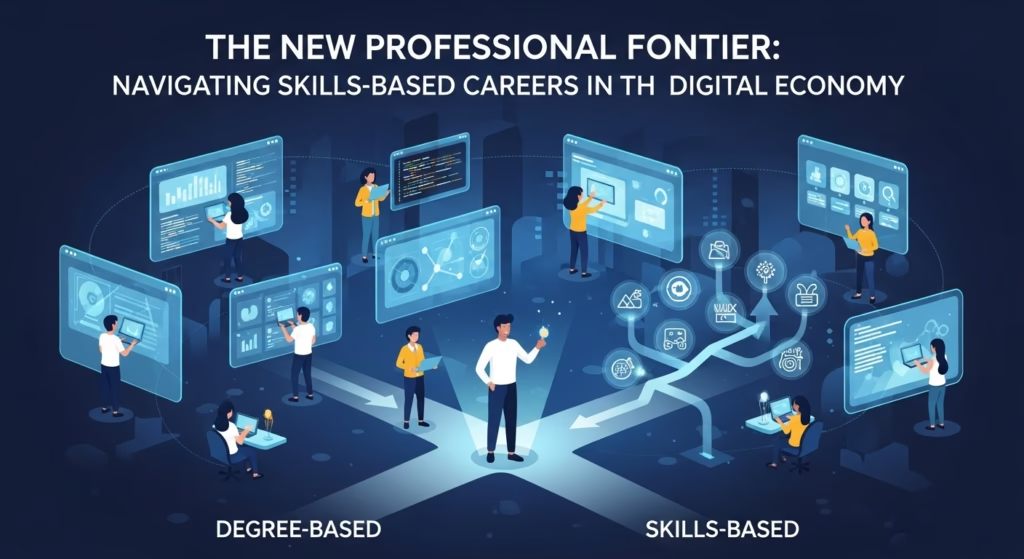
The New Professional Frontier: Navigating Skills-Based Careers in the Digital Economy
The traditional roadmap of professional success—a four-year degree followed by a linear climb up the corporate ladder—is undergoing a fundamental restructuring. As technological advancement outpaces academic curricula, the global labor market is pivoting toward a “skills-first” philosophy. This shift is most visible in high-growth sectors such as SaaS sales, cybersecurity, digital marketing, and technical operations. In this new landscape, skills-based careers and demonstrated competency are replacing the diploma as the primary currency of the modern workforce.
For decades, the bachelor’s degree served as a blunt proxy for talent. Employers used it as a filtering mechanism, assuming that the completion of a degree signaled discipline, intelligence, and a baseline level of socialized professional behavior. However, in an era where the half-life of a technical skill is estimated to be only five years, the static nature of a university education is struggling to keep pace with the dynamic needs of industry. We are entering an age where what you can do matters infinitely more than where you learned to do it. This transformation is part of a broader 2025 AI Evolution: From Prompts to Agentic Business Strategy where specialized, adaptable skills define value.
The Rise of Skills-Based Hiring and Degree-Free Career Paths
A seismic shift is occurring in human resources and talent acquisition. According to recent industry data, the number of job postings in the United States that do not require a four-year degree increased by 33% between 2021 and 2022 alone. This is not a temporary reaction to labor shortages, but a permanent strategic pivot. Major corporations, including Google, IBM, and Accenture, have publicly removed degree requirements for a significant portion of their roles. This movement highlights that skills-based hiring is on the rise as companies realize that some of their most capable innovators come from non-traditional backgrounds.
For the individual professional, this creates a more equitable and accessible landscape. Degree-free career paths allow professionals to enter high-paying industries through alternative credentials, specialized bootcamps, and rigorous self-directed learning. Research indicates that skills-based hiring is five times more predictive of job performance than educational background and 2.5 times more predictive than work experience alone. When an employer tests for the specific ability to write code, close a deal, or secure a network, they are getting a much clearer picture of future performance than a GPA could ever provide.
The return on investment (ROI) of this approach is significant. By bypassing traditional student debt and entering the workforce two to four years earlier, “new collar” workers can gain a massive head start on compounding their earnings. The focus has moved from “What did you study?” to “What problems can you solve?” This shift is deeply documented in [the 2024 Future of Work Report], which suggests that agility and continuous upskilling are the new requirements for career longevity.


High-Ticket SaaS Sales and Remote Business Development
Software as a Service (SaaS) remains one of the most lucrative industries for those with strong interpersonal and strategic skills. Within this sector, “high-ticket” sales—referring to enterprise-level software contracts typically exceeding $50,000 to $100,000 annually—offer a unique path to high income without requiring a technical background. As companies globally increase their digital toolkits, the demand for people who can navigate these complex sales cycles is booming, reflected in the latest [forecast analysis for worldwide public cloud spending].
The role of a Sales Development Representative (SDR) or Business Development Representative (BDR) serves as the primary entry point. In a remote-first world, these roles have transitioned from cubicle-based cold calling to sophisticated, multi-channel outreach strategies. Modern business development involves a mix of social selling, data-driven prospecting, and psychological resilience.
The Mechanics of Remote High-Ticket Sales:
- Lead Research and Qualification: Success in high-ticket sales begins with precision. Using tools like LinkedIn Sales Navigator and ZoomInfo, modern reps identify high-value targets and research their fiscal year priorities. They aren’t looking for anyone; they are looking for the specific decision-maker experiencing the exact pain point their software solves.
- Consultative Selling: The “hard sell” is dead in the enterprise world. Modern sales is a diagnostic process. It involves asking the right questions to uncover organizational inefficiencies and then mapping the software’s features to the prospect’s specific business outcomes.
- Pipeline Management: Mastering CRM systems like Salesforce or HubSpot is essential. Because high-ticket cycles can last six to eighteen months, a representative must be an expert at managing complex stakeholder environments, ensuring that every touchpoint adds value.
High-ticket SaaS sales favor those who can manage complex social dynamics and understand the macro-business impact of technology. Remote business development allows professionals to work for Silicon Valley or London-based firms from anywhere in the world. With base salaries often starting at $60,000 and uncapped commission structures, it is not uncommon for dedicated individuals to reach six-figure earnings within their first 18 months of employment.
Cybersecurity: Entry-Level Pathways and the Global Talent Gap
The digital economy is built on trust, and that trust is under constant siege. Consequently, cybersecurity is currently facing a global shortage of approximately 3.5 million professionals. This staggering talent gap has forced the industry to look beyond traditional computer science degrees and toward specific certification pathways that prove technical proficiency. This sector is particularly well-suited for the skills-based model because security threats evolve faster than any university textbook can be updated.
According to the 2024 Cybersecurity Jobs Report, the demand for defenders is outpacing the supply of new graduates by a wide margin. For those entering the field, the path is structured, predictable, and heavily reliant on industry-standard certifications:
- CompTIA Security+: Often the baseline requirement for any entry-level security role. It covers the core principles of network security and risk management and is highly sought after by large enterprises.
- Certified Ethical Hacker (CEH): This certification provides a foundation in penetration testing and offensive security. It teaches candidates how to think like an adversary to better defend their own systems.
- GIAC Information Security Fundamentals (GISF): A highly respected credential for those entering the field from non-technical backgrounds, focusing on core terminology and architectural concepts.
The “entry-level” cybersecurity role often manifests as a Security Operations Center (SOC) Analyst. In this role, individuals monitor networks for suspicious activity and respond to security alerts. Because the demand is so high, many companies now offer “upskilling” programs where they hire candidates based on aptitude and pay for their advanced certifications as they progress.
Digital Marketing Specialization and SEO Management
Digital marketing has evolved from a generalist field into a collection of highly technical specializations. The era of the “social media manager” who simply posts photos and hopes for engagement is being replaced by the SEO Manager and the Performance Marketer—roles that require a blend of data science and creative strategy. This is especially true when implementing a How to Master Human-in-the-Loop AI Content Creation Guide to ensure content quality.
Search Engine Optimization (SEO) Management
SEO is no longer just about “stuffing” keywords into a blog post; it is about user experience, technical site architecture, and building content authority. An SEO Manager in a high-growth company must understand three distinct pillars:
- Technical SEO: This includes managing site speed, schema markup, mobile-first indexing, and ensuring that a site’s architecture is crawlable by search engine bots. It is a role that sits halfway between marketing and web development.
- On-Page SEO: This involves content optimization and keyword mapping, but more importantly, it requires user intent analysis. The goal is to ensure that the content provided exactly matches what the user is searching for.
- Off-Page SEO: This is the strategic process of building high-quality backlink profiles and managing brand authority across the web. It requires PR skills, relationship building, and a deep understanding of how the internet links information together.
The shift toward specialization means that deep expertise in one niche (like Programmatic Advertising or Technical SEO) often commands a higher salary than a broad knowledge of all marketing channels. As companies increasingly prioritize organic growth over paid acquisition due to rising ad costs, the SEO Manager has become a central figure in the marketing department.

Remote Project Management and the Scrum Master
As organizations transition to remote and hybrid models, the need for structured coordination has skyrocketed. Project management has moved from an administrative task to a strategic necessity. The primary challenge in remote work is maintaining alignment without the physical presence of a team, making the project manager the “glue” that holds distributed teams together.
The Scrum Master role is particularly vital in software development and creative agencies. Using the Agile framework, a Scrum Master facilitates “sprints,” removes blockers for the development team, and ensures that the project remains aligned with the product owner’s vision. They are not “bosses” in the traditional sense; they are servant-leaders who optimize the team’s flow.
Essential Certifications for Remote Project Managers:
- Certified ScrumMaster (CSM): The most recognized entry-point for Agile practitioners, focusing on the mechanics of the Scrum framework and the philosophy of iterative development.
- Project Management Professional (PMP): The gold standard for general project management. While it requires significant documented experience, it remains one of the most respected credentials in the corporate world.
- Professional Scrum Master (PSM I): A rigorous, competency-based certification from Scrum.org that is highly valued by technical organizations for its focus on deep Agile principles.
Remote project management requires mastery of asynchronous communication tools like Jira, Asana, and Monday.com. The ability to manage a team across multiple time zones without micro-management is the defining skill of the modern PM.
Technical Writing for High-Growth Software Companies
Technical writing is one of the most underrated and high-potential career paths in the tech industry today. As software becomes more complex and specialized, the need for individuals who can bridge the gap between engineers and end-users has never been greater. This role is ideal for those with strong linguistic skills who are also comfortable navigating technical environments.
In high-growth software companies, technical writers do more than just write manuals; they participate in “Docs-as-Code” workflows. This means they use the same tools as developers (like GitHub and Markdown) to manage documentation. Their work includes:
- API Documentation: Writing the technical specs that allow different software programs to talk to each other.
- User Experience (UX) Writing: Collaborating with designers to ensure the software’s interface is intuitive. Every button label and error message is an opportunity to reduce user frustration.
- Knowledge Base Management: Creating “Getting Started” guides and tutorials that help new customers find value in a product quickly, which directly reduces customer churn.
The demand for technical writers is driven by a simple truth: even the best software is useless if people cannot figure out how to use it. Professionals with a background in English or communications who can learn basic technical skills are finding highly stable, remote-friendly roles with competitive salaries.
Virtual Operations and Business Systems Management
Behind every successful remote company is a complex web of integrated systems. This has given rise to the Virtual Operations Manager or Business Systems Manager. This role is responsible for the “tech stack”—the collection of software tools a company uses to operate, communicate, and generate revenue.
In the past, operations meant managing a physical office. Today, it means managing the flow of data between different cloud-based applications. A Business Systems Manager might spend their day:
- Automating Workflows: Using tools like Zapier or Make to ensure that when a lead fills out a form, their info is automatically sent to the CRM and a notification is sent to Slack.
- Data Integrity: Ensuring that the information in the sales department’s tools matches the information in the accounting department’s tools.
- Internal Knowledge Management: Organizing a company’s internal “brain” in tools like Notion or Confluence to ensure that remote employees can find the information they need.
This role is the backbone of the modern decentralized organization. It requires a “systems thinking” mindset—the ability to see how a change in one department’s software will affect another’s data flow.

The Future of the “New Collar” Workforce
The common thread across these domains is the decoupling of career success from traditional academic credentials. Whether it is a Scrum Master certification, a portfolio of SEO successes, or a CompTIA Security+ badge, the focus of the modern economy has shifted toward verifiable proof of ability. We are moving toward a continuous learning model where “just-in-case” education (the four-year degree) is being replaced by “just-in-time” learning—specific certifications and skill badges acquired exactly when they are needed.
This transition represents the birth of the “New Collar” workforce. These are roles that prioritize technical aptitude and “soft” skills like communication and problem-solving over a specific pedigree. For the modern professional, the strategy is clear: identify a high-growth niche, acquire the specific technical certifications required, and leverage the remote economy to find roles that value output over office attendance.
The “degree-free” path is not necessarily the easier path. In many ways, it is more demanding, as it requires a lifetime of constant upskilling and the self-discipline to stay current in a world where the landscape changes every quarter. However, for those willing to embrace this shift, it is increasingly the most direct and rewarding route to professional and financial autonomy in the 21st century. The digital economy does not care about your diploma; it cares about what you can build, secure, sell, and manage today.