


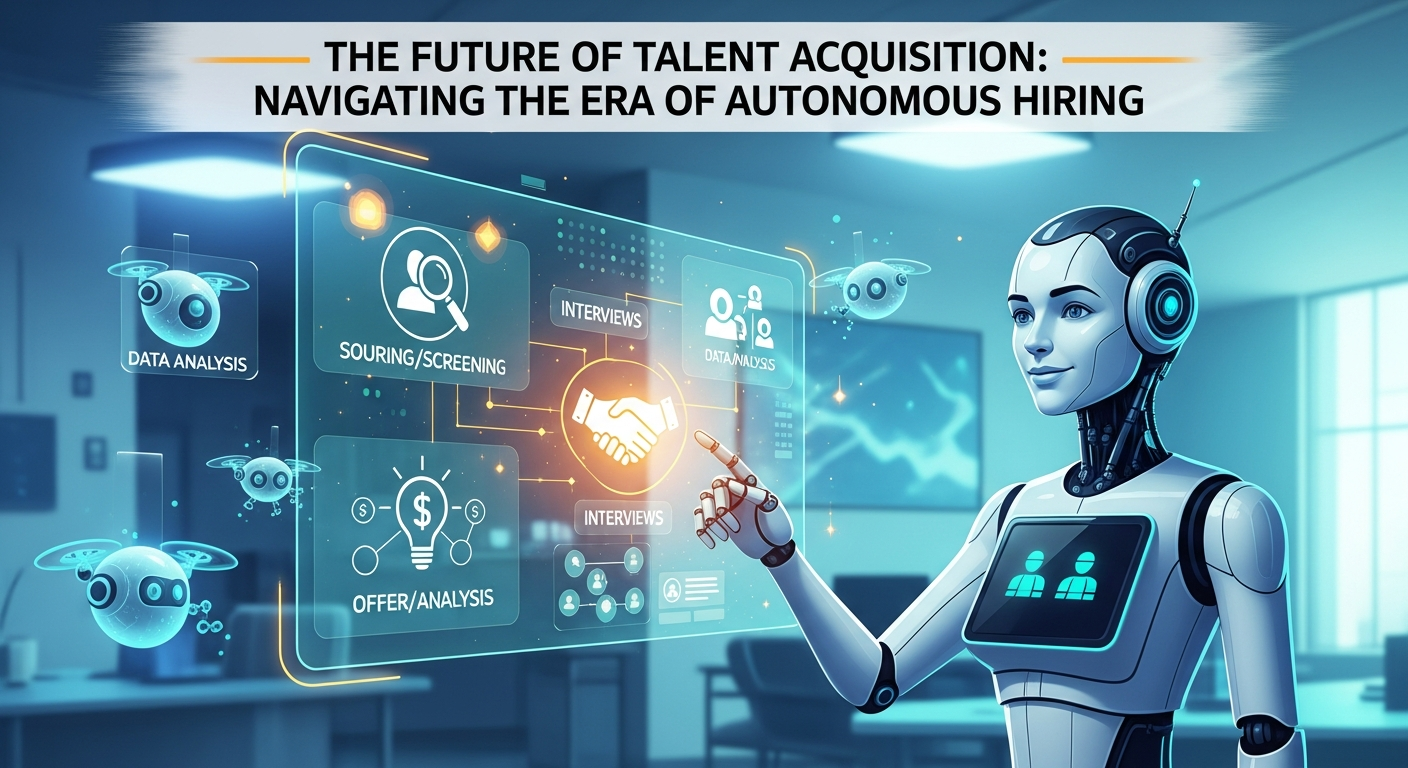
The Future of Talent Acquisition: Navigating the Era of Autonomous Hiring
The landscape of talent acquisition is undergoing a fundamental transformation as artificial intelligence evolves from a simple administrative aid into a fully autonomous hiring agent. This evolution is reshaping the traditional talent lifecycle management by introducing Agentic AI: The Future of Autonomous Multi-Agent Systems into the recruitment stack. What was once limited to basic keyword matching is now becoming a sophisticated ecosystem capable of managing candidate engagement on autopilot.
Efficiency Gains and Performance Metrics
The primary driver behind this shift is the unprecedented efficiency gain in performance metrics. Benchmarking data shows that AI-driven video interview platforms can slash total hiring time by as much as 90%. In the United Kingdom, HR professionals have reported that integrating these tools leads to a consistent 40% reduction in time-to-hire.
This acceleration is made possible by automating high-volume, repetitive tasks—such as parsing thousands of resumes in a matter of minutes—and utilizing the latest AI recruitment market trends to predict which candidates will integrate most effectively into a company culture.
The New Frontier of Conversational Video Technology
As we approach 2025, conversational video technology is emerging as the new frontier for first-round interactions. Modern machine learning models no longer just record video; they analyze candidate sentiment, skills, and experience in real-time. Platforms like HeroHunt and Recooty are leading this charge, integrating deep learning to ensure precise candidate-to-job matching.
These autonomous systems are now handling everything from passive talent sourcing to complex interview logistics, allowing human recruiters to focus on final-stage relationship building. By offloading the initial screening to intelligent agents, organizations can maintain a high-touch feel even at a massive scale.
Ethical Considerations and Algorithmic Fairness
However, the rapid adoption of these technologies brings significant ethical considerations to the forefront. The use of biometrics and location tracking in some platforms has led to the creation of the Bossware and Employment Tech Database, which monitors how these tools are deployed in the workplace and their impact on worker privacy.
The tension between efficiency and equity is central to current industry debates. Critics and researchers alike warn that while AI can eliminate certain human prejudices, algorithmic fairness remains a moving target. As explored in the research regarding Fairness and Machine Learning: Limitations and Opportunities, institutional decisions made by AI must be rigorously audited to prevent the perpetuation of historical biases in candidate selection.
Balancing Automation with Human Accountability
Ultimately, the 2025-2026 recruitment market will be defined by those who can successfully merge the logistical power of AI with a human-centric ethical framework. For organizations to truly benefit from autonomous hiring, they must balance the speed of automated matching with a commitment to accountability and transparent selection criteria.
By leveraging these advanced tools for sourcing, engagement, and logistics while maintaining a watchful eye on algorithmic integrity, companies can build more agile, effective, and fair hiring pipelines.