


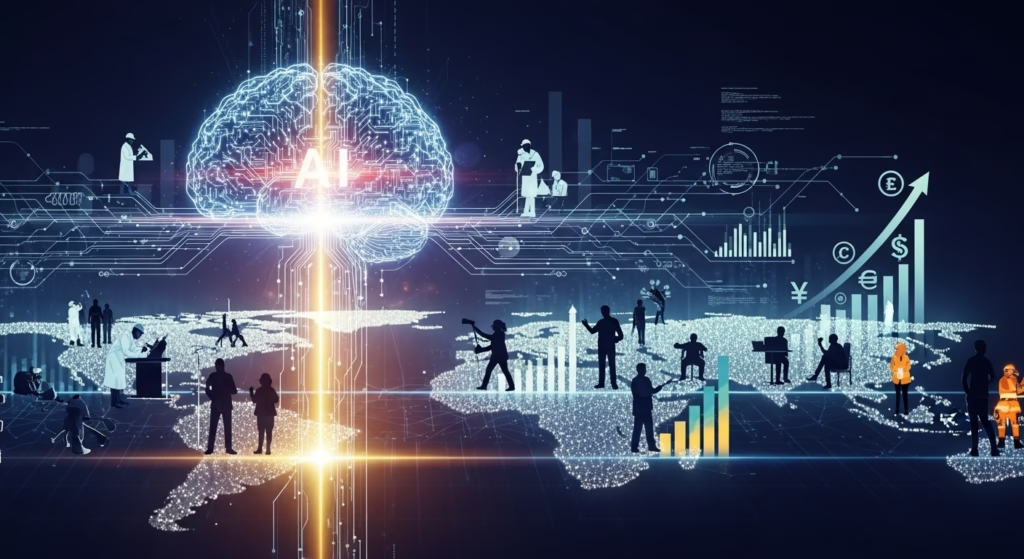
The Global AI Revolution: Economic Growth and the Future of Work
The advent of Artificial Intelligence is not merely an evolutionary step but a profound revolution, poised to reshape global economies, industries, and the very nature of work. The financial commitment to this transformation is staggering, with global expenditure on AI projected to reach approximately $2.52 trillion by 2026. Generative AI alone is estimated to contribute an astonishing $2.6 trillion to $4.4 trillion annually to the global economy. This unprecedented value creation is fundamentally driven by automation across diverse sectors, exerting a significant influence on labor markets.
As organizations move toward Agentic AI: The Future of Autonomous Multi-Agent Systems, around 75% of surveyed companies are expected to adopt AI technologies within the next five years. This shift focuses on task automation and boosting operational efficiency. National strategies, such as India’s comprehensive “AI for All,” further underscore a broader vision to harness these technologies for societal inclusion and large-scale economic transformation, particularly in critical sectors like education, healthcare, and agriculture.
Job Market Transformation and Fractional Leadership
This technological surge is intrinsically linked to a dramatic shift in the professional services landscape. According to the World Economic Forum’s Future of Jobs Report 2023, nearly 23% of global jobs are anticipated to undergo transformation by 2027 due to these groundbreaking technological advancements. To navigate this, businesses are increasingly looking toward the future of talent acquisition and autonomous hiring trends to bridge critical skills gaps in emerging fields such as AI and cybersecurity.
In response, many firms are turning to specialized outsourcing and hiring “fractional” executives. This approach allows companies to access high-level expertise without the substantial overhead associated with full-time executive hires, fostering agility in a volatile market where maintaining a lean, adaptable structure is paramount.
Sustainable Development and ESG Integration
Beyond internal operational shifts and workforce recalibrations, sustainable development and Environmental, Social, and Governance (ESG) criteria are rapidly becoming central to industrial policy and global trade. For emerging economies, such as Vietnam, the transition to green energy and the implementation of sustainable practices are increasingly seen as vital for maintaining industrial competitiveness, a point highlighted in the World Bank’s Viet Nam 2045 – Trading Up in a Changing World report.
As global trade regulations continue to tighten, businesses are finding ESG consulting indispensable for navigating complex compliance requirements and integrating sustainability throughout their core supply chains. This embrace of sustainability functions as a “trading up” mechanism, effectively becoming a prerequisite for market entry into high-value global segments.
Navigating Digital Risks and Cybersecurity
As businesses accelerate their automation initiatives, the digital risk surface invariably expands. This necessitates robust regulatory frameworks and cybersecurity measures to manage the ethical and security implications of rapid digital adoption. Risk management now encompasses not only traditional data protection but also extends to ensuring the reliability and integrity of AI-driven decision-making systems.
Consequently, cybersecurity compliance has evolved beyond a reactive IT function into a strategic business imperative. This is frequently supported by specialized third-party risk management experts who help fortify defenses against an increasingly sophisticated threat landscape, ensuring that automated systems remain both secure and compliant.
The Future of Digital Marketing Strategy
Even as macro trends focus on industrial AI and global policy, the digital marketing landscape is simultaneously being reshaped by algorithmic shifts. The demand for digital marketing and strategy roles remains high as service-based businesses integrate short-form video content and highly localized SEO to maintain visibility. While Generative AI tools offer powerful capabilities for rapidly scaling localized content, success hinges on specialized oversight to ensure brand consistency. In an automated world, the human touch remains crucial for maintaining algorithmic relevance and brand integrity.