Apple Intelligence & Silicon: The Privacy-First AI Revolution
Apple Intelligence and Silicon: Redefining the Privacy-First AI Ecosystem
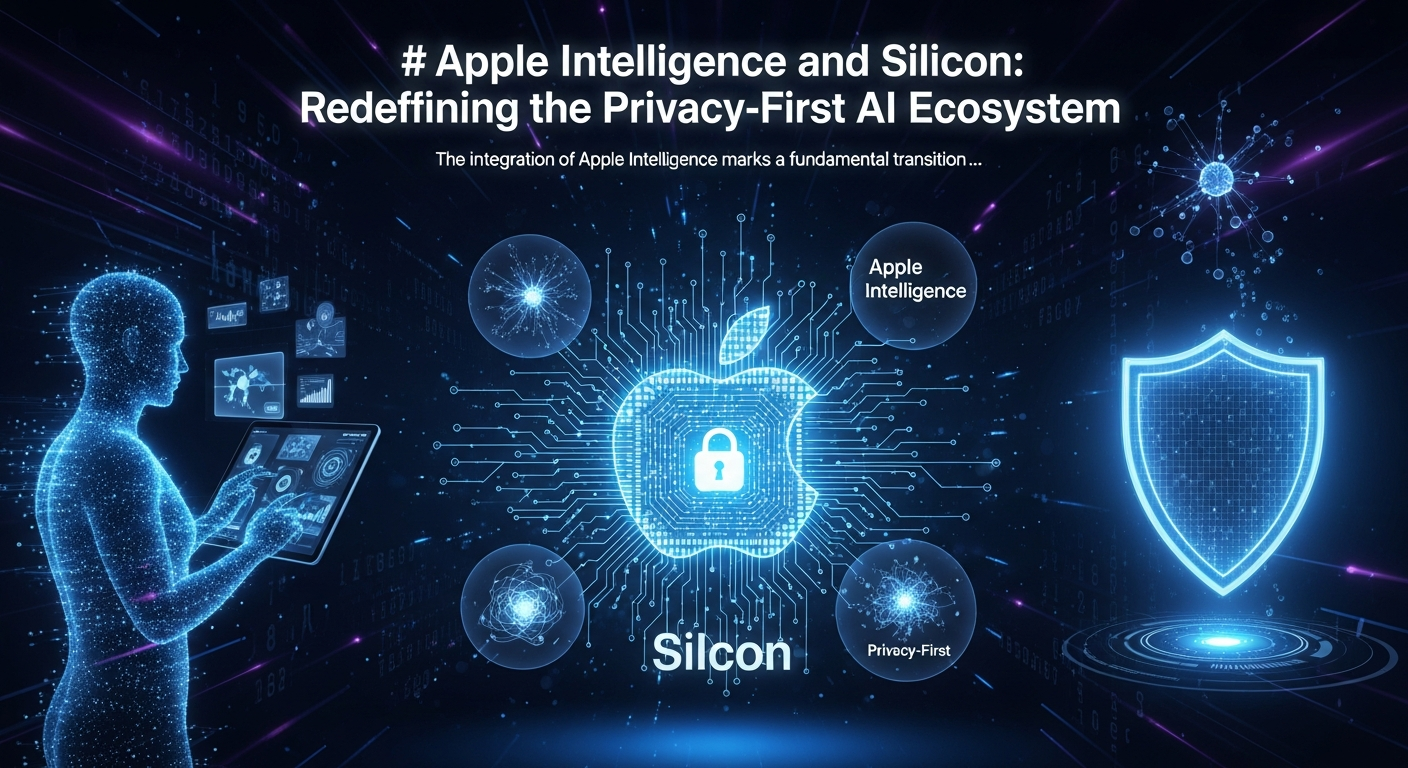
The integration of Apple Intelligence marks a fundamental transition in Apple’s software engineering philosophy, moving from traditional heuristic-based algorithms to a pervasive generative AI ecosystem powered by transformer-based models. This shift is predicated on a “Privacy-First AI” mandate, which differentiates Apple from competitors who rely on massive, centralized cloud clusters. In the context of the future of computing, Apple Intelligence, visionOS, and Silicon are converging to create a dual-tier processing model designed to balance high-performance inference with rigorous data sovereignty.
The Evolution of Apple Intelligence: A Paradigm Shift in Generative AI
For over a decade, artificial intelligence at Apple was largely defined by Siri—a system that relied heavily on intent recognition and pre-defined response trees. While effective for simple tasks like setting timers or checking the weather, it struggled with the nuance and conversational depth introduced by the current wave of Large Language Models (LLMs). The emergence of Apple Intelligence represents a complete rebuild of this intelligence layer, moving toward a more fluid, context-aware interaction model.
By integrating generative models directly into the core of iOS, iPadOS, and macOS, Apple is not just adding a chatbot; it is re-engineering how the operating system understands user intent. This new architecture prioritizes “Personal Context.” Instead of a generic AI that knows everything about the internet but nothing about you, Apple Intelligence is designed to understand your specific world—your emails, your calendar, your messages, and your photos—all while maintaining a cryptographic wall between your personal data and the outside world. This reflects broader trends where generative AI and human-centric innovation reshape work by emphasizing personalization over generic automation.
The On-Device Foundation and Model Optimization
The primary tier of Apple Intelligence is the on-device foundation model, specifically a high-efficiency 3-billion parameter Large Language Model. To ensure this model runs effectively on the Apple Silicon Neural Engine without compromising battery life or thermal stability, Apple utilizes sophisticated “Model Quantization” techniques.
Quantization is the process of reducing the precision of the numbers (weights) that represent the model’s knowledge. While a standard model might use 16-bit floats, Apple employs 4-bit and bit-scaled quantization. This significantly reduces the memory footprint of the model weights, allowing a powerful LLM to reside in the limited RAM of an iPhone or iPad while maintaining high perplexity scores—a measure of how well the model predicts the next word in a sequence.
A critical innovation in this space is the use of “Adapter” technology. Rather than loading multiple specialized models for different tasks—such as writing assistance, mail summarization, or Siri requests—Apple uses a single base model that is dynamically modified by small, task-specific parameter sets known as adapters. This allows for specialized performance across different applications with minimal memory overhead. When a user switches from writing an email to searching for a photo, the system simply swaps out a small “adapter” layer rather than reloading a multi-gigabyte model.
Furthermore, Apple employs “Speculative Decoding.” In this process, a smaller, faster “draft” model predicts potential tokens (words or parts of words) at high speed. These predictions are then verified in parallel by the larger foundation model. If the larger model agrees with the draft, the text appears instantly. This drastically increases the speed of text generation, making the AI feel responsive and fluid rather than lagging.
Private Cloud Compute (PCC) and Stateless Processing
When a user request exceeds the computational limits of on-device hardware—such as complex reasoning tasks or massive data synthesis—Apple Intelligence utilizes “Private Cloud Compute” (PCC). This is a breakthrough in “Stateless Computation,” where dedicated servers powered by Apple Silicon (M-series chips) process data without ever storing it.
Unlike traditional cloud AI, which may log user data for model training or debugging, PCC is built with “Verifiable Transparent Logging.” This architecture ensures that the server-side code is cryptographically signed and verifiable by independent security researchers. If the security of the PCC node cannot be verified, the device will refuse to send data. This “Data Minimization” strategy ensures that even Apple employees cannot access the data being processed.
The security requirements for PCC are unprecedented. According to the Private Cloud Compute security details, the system is designed so that user data is only ever used for the specific request and is destroyed immediately after the response is generated. Career paths in this sector are currently focusing on AI Ethics, Safety, and Verifiable Systems Engineering, as Apple seeks to hard-code guardrails against hallucinations and bias directly into the model’s architectural layers.

Spatial Computing and visionOS: Reimagining Human-Computer Interaction
The launch of Apple Vision Pro and visionOS has established “Spatial Computing” as a major hardware and software vertical. This domain requires a unique blend of traditional software engineering, 3D game engine mechanics, and perceptual psychology. The goal is to move beyond the “screen” and into an environment where digital and physical realities coexist seamlessly.
Low-Latency Rendering and the R1 Processor
The visionOS architecture is designed to maintain the “immersion” of digital objects within a 3D volumetric space. Central to this is the R1 chip, a dedicated processor that handles inputs from 12 cameras, five sensors, and six microphones. The R1 is engineered for “Low-Latency Rendering,” ensuring that images are streamed to the 4K micro-OLED displays within 12 milliseconds—eight times faster than the blink of an eye.
This speed is critical to eliminating motion sickness. In a spatial environment, even a slight delay between a user’s head movement and the display update can cause “sensory mismatch,” leading to nausea. By keeping latency below the human perception threshold, visionOS ensures that virtual objects appear anchored in the real world with rock-solid stability.
Human Factors and 3D Interface Design
“Spatial Software Engineering” roles now prioritize “3D Human Interface Design.” Unlike 2D screens, visionOS utilizes “Eye-Tracking Calibration” and “Gesture-Based Interaction.” Developers must follow strict visionOS engineering documentation to ensure that interactive elements are placed within a comfortable “field of focus” and respond naturally to subtle hand movements like a look and pinch.
This has led to an increased demand for “Human Factors Engineering,” a field dedicated to studying the biomechanics of the user. Engineers must account for eye strain, neck fatigue, and the physical comfort of wearing high-end sensors. This involves “Foveated Rendering,” where the system only renders the area the user is looking at in full resolution, saving massive amounts of computational power while mimicking the natural function of the human eye.
In terms of audio, “Spatial Audio Engineering” has become a critical requirement. visionOS uses “Audio Ray-Tracing” to map the acoustics of a room in real-time. This ensures that a virtual sound source—such as a movie screen or a FaceTime window—sounds as though it is physically present in the specific environment of the user, reflecting off walls and surfaces with mathematical precision.
Proprietary Apple Silicon: The Vertical Integration Advantage
Apple’s transition to its own silicon has provided a structural advantage that allows for the tightest vertical integration in the industry. The current focus is on “Application-Specific Silicon Architecture,” where chips are no longer general-purpose but are custom-tailored for AI, imaging, and security.
Unified Memory Architecture (UMA) and N3E Process Nodes
The “secret sauce” for running LLMs on Apple hardware is the “Unified Memory Architecture” (UMA). In a traditional computer, the CPU and GPU have separate memory pools, requiring data to be copied back and forth over a slow bus. By placing the CPU, GPU, and Neural Engine on a single die with a shared, high-bandwidth memory pool, Apple eliminates this latency.
This is particularly important for generative AI, where model weights are massive. UMA allows the Neural Engine to access the entire system memory instantly, enabling devices like the MacBook and iPad Pro to handle AI model weights that would stall a traditional PC. This efficiency is why an 8GB Mac can often outperform a 16GB Windows laptop in specific AI inference tasks.
As Apple pushes into the N3E (3nm) and eventually 2nm process nodes, “Thermal Modeling” has become a vital engineering discipline. Devices like the M4 iPad Pro, which is only 5.1mm thick, require engineers to maximize “Performance-per-Watt.” The goal is to squeeze maximum computational power out of a minimal thermal envelope, necessitating advancements in Power Management Integrated Circuits (PMICs) and VLSI (Very Large Scale Integration) Design.

Sustainability and the “Apple 2030” Mandate
The “Apple 2030” initiative is a corporate-wide mandate to make every Apple product carbon neutral by the end of the decade. This is not merely a policy goal but a deep-seated engineering challenge that has redefined roles in supply chain management and material science. It represents a commitment to the environment that parallels the commitment to privacy.
Closed-Loop Manufacturing and Material Innovation
Apple is aggressively pursuing a “Closed-Loop” supply chain, with the ultimate goal of sourcing 100% of its materials from recycled or renewable sources. This is a monumental task that requires re-engineering how products are put together—and taken apart. According to Apple’s 2024 Environmental Progress Report, the company is now using 100% recycled cobalt in all Apple-designed batteries and 100% recycled gold in the plating of multiple printed circuit boards.
To facilitate this, Apple has developed proprietary recycling robots:
* Daisy: Capable of disassembling 200 iPhones per hour to recover high-purity materials.
* Taz: A machine designed to improve the recovery of rare earth elements from electronics shredding.
* Dave: A robot that disassembles Taptic Engines to recover rare earth magnets and tungsten.
Carbon-Neutral Operations and the Restore Fund
Beyond hardware, Apple is working with over 300 global suppliers to transition to 100% renewable energy. The “Life Cycle Assessment” (LCA) has become a standard metric for every new product, calculating carbon impact from raw material extraction to final disposal.
To offset unavoidable emissions, Apple manages the “Restore Fund,” a nature-based investment vehicle. This fund focuses on reforestation and carbon removal projects that are verified through rigorous scientific standards. The goal is to create a blueprint for other companies to invest in the environment while also generating a financial return, proving that sustainability is a viable business strategy.
Privacy-Centric Software and Cybersecurity
Privacy at Apple is treated as a foundational product feature, leading to a “Privacy-Centric Engineering” culture. This vertical is dominated by “Data Minimization” and “Differential Privacy.” This philosophy is core to how the company approaches all new features, especially those involving sensitive user data and AI.
Secure Enclave and Hardware Isolation
The “Secure Enclave” (SEP) provides a hardware-isolated environment for the most sensitive user data. This co-processor handles the biometric maps for FaceID and TouchID, as well as the encryption keys for Apple Pay. “Low-Level Security Engineers” at Apple work on hardening the boundary between the main OS kernel and the SEP. The design philosophy is simple: the main processor should never have access to the actual biometric data, only a “yes/no” confirmation from the SEP.
This isolation prevents “Side-Channel Attacks,” where a hacker might try to monitor power consumption or electromagnetic leaks to steal keys. By isolating these processes at the silicon level, Apple ensures that even if the main operating system is compromised, the user’s most sensitive credentials remain safe.
Differential Privacy and Cryptography
Apple uses “Differential Privacy” to gather aggregate usage data without identifying individual users. By injecting mathematical “noise” into the data before it leaves the device, Apple can identify trending search terms or popular emojis while mathematically proving that the source data cannot be reconstructed to identify a single person.
In the era of AI, this extends to “Semantic Indexing.” When Apple Intelligence needs to know about your “upcoming trip to Tokyo,” it doesn’t send your emails to a server to be read. Instead, a semantic index is built locally on your device. When a query is made, the system looks up the information in this local, encrypted index. This ensures that personal context powers Siri’s intelligence without that data ever being accessible to Apple’s servers or third-party developers.
Inclusive Design and Accessibility
Apple’s commitment to accessibility is driven by the philosophy of “Inclusive Design,” where tools created for users with disabilities often become innovations for the broader market. The engineering team views accessibility not as a checklist, but as a source of creative constraint that leads to better products for everyone.
Neurodiversity UX and Cognitive Accessibility
New career paths have opened for “Neurodiversity UX” specialists. Features like “Assistive Access” simplify the iOS interface into high-contrast, large-button layouts, which are invaluable for individuals with cognitive disabilities, dementia, or ADHD. These features strip away the complexity of the modern smartphone, focusing on core functions like calling, messaging, and photos.
Similarly, “Eye-Tracking” on iPad—initially developed as an assistive tool for those with limited mobility—has become the foundational interface for the Vision Pro. This “cross-pollination” of technology demonstrates how solving problems for a specific subset of users can result in a breakthrough for the entire user base.
Multi-Sensory Navigation
Engineers are also refining “Haptic Navigation” and “Sound Recognition.” These features allow users who are deaf or hard of hearing to receive alerts for sounds like doorbells, sirens, or crying babies via haptic pulses on their Apple Watch or visual cues on their iPhone.
The “SignTime” service provides on-demand sign language interpreters for retail and support, showcasing a commitment to “Human-Centric Service Design.” This holistic approach ensures that technology serves as a bridge rather than a barrier, regardless of a user’s physical or cognitive abilities.
Retail Leadership and the “Town Square” Strategy
The Apple Store has evolved from a retail outlet into a “Town Square” focused on community education and “Brand Advocacy.” The focus is no longer on shifting boxes, but on fostering a long-term relationship with the user. This strategy requires a unique set of skills in pedagogy, empathy, and technical expertise.
Creative Pros and Today at Apple
The role of the “Creative Pro” is central to this shift. These are not sales roles but mentorship positions where experts in video, photography, coding, and music teach customers how to use Apple tools through “Today at Apple” sessions. This requires “Soft Skills” and “Pedagogical Leadership,” moving the metric of success from a transaction to “Customer Success.”
In these sessions, a customer might learn how to edit a cinematic video on an iPad or how to build their first app in Swift Playgrounds. By turning the retail space into a classroom, Apple builds a community of power users who are deeply integrated into the ecosystem.
Omni-channel Integration
Retail leadership now focuses on “Omni-channel Integration,” ensuring a seamless transition between the digital Apple Store app and the physical retail environment. This includes “Personal Setup” sessions, where customers receive one-on-one help to migrate data and customize their new devices.
This service-first approach extends to the “Genius Bar,” where technical support is reimagined as a face-to-face conversation rather than a ticket-based system. The goal is to ensure a premium experience from the first moment of ownership, reinforcing the idea that when you buy an Apple product, you are also buying into a support and education network.

Technical Summary: The Modern Apple Stack
The modern Apple engineer works at the intersection of several specialized disciplines that were once considered separate. This convergence is what defines the current era of the company. As the industry evolves, how AI and robotics are redefining the global economy becomes a key consideration for anyone entering the tech workforce.
- Swift and MLX: Utilizing Apple’s custom machine learning framework (MLX) to train and fine-tune models directly on Mac hardware. MLX is designed specifically for Apple Silicon, allowing for efficient use of the GPU and Neural Engine.
- Core ML Optimization: Mapping transformer layers to the Neural Engine for real-time inference. This involves understanding the specific math operations that the Neural Engine can accelerate and “pruning” models to fit those constraints.
- Verilog and VLSI: Designing the next generation of 2nm silicon. Engineers are already working years into the future to define the instruction sets that will power the AI of 2030.
- Cryptography: Ensuring “Private Cloud Compute” remains the most secure AI cloud in existence. This requires a deep understanding of post-quantum cryptography and verifiable computation.
By vertically integrating these disciplines—from the raw materials of the hardware to the high-level intent recognition of the AI—Apple has created a unique career landscape. It is a landscape that prioritizes privacy, power efficiency, and user-centric innovation over raw, unconstrained computational scale. In the world of Apple Intelligence, the most powerful tool is not the one that knows the most, but the one that knows you best while keeping your secrets safe.