

10 Pillars for Humanizing AI Professional Content
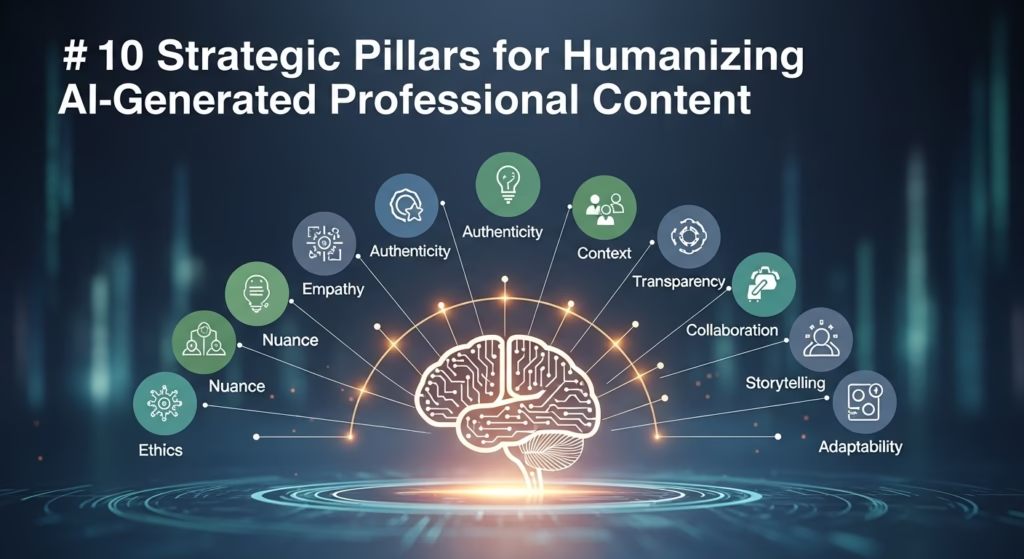
10 Strategic Pillars for Humanizing AI-Generated Professional Content
As artificial intelligence becomes a standard fixture in the content creation workflow, the challenge for professionals has shifted from generation to differentiation. To maintain authority and resonance, humanizing AI-generated content is essential to transcend the robotic neutrality of standard outputs. Professional writers and marketers must now focus on high-impact refinement to ensure their work stands out in an increasingly automated landscape. Here are ten strategic pillars for transforming AI-drafted text into authoritative professional content.
1. Structural Subversion: Reordering the Narrative Flow
Standard Large Language Models (LLMs) typically follow a linear, predictable outline: introduction, definition, features, and conclusion. To capture professional attention in a crowded marketplace, writers must subvert this by prioritizing unique, high-level strategic insights at the beginning. This “inverted pyramid” approach ensures that the most valuable proprietary information is not buried under generic definitions that AI defaults to for word-count padding.
2. Linguistic Scrubbing: Eliminating the “AI Dialect”
AI outputs are often characterized by specific repetitive descriptors such as “tapestry,” “delve,” “vibrant,” and “unlocking.” These terms function as linguistic fingerprints that alert readers and search engine classifiers to machine-generated origins. Professional refinement requires replacing these artifacts with industry-specific terminology and precise verbs that convey direct action rather than metaphorical fluff.
3. Proprietary Narrative Infusion (Experience-First Content)
Under the current standards for creating helpful, people-first content, personal anecdotes and internal case studies are the most effective way to differentiate your work. LLMs cannot replicate lived professional experiences or private company data. Integrating “zero-party” data and unique project outcomes provides a layer of authenticity that makes the content uncopiable by competitors using the same prompts.
4. Primary Source Fact-Verification and Hallucination Auditing
Research indicates that hallucination rates in frontier models can range from 3% to 15% depending on the complexity of the query. Every statistic, legal citation, and technical claim must be cross-referenced with authoritative databases. Reliable content must distinguish between a model’s plausible-sounding sentences and verifiable empirical data to maintain professional credibility.
5. Hyper-Calibration of Brand Voice
The default persona of most AI is a “helpful, neutral assistant.” Professional content must move beyond this baseline to reflect a specific brand identity—whether that is visionary, skeptical, or highly technical. Following a How to Master Human-in-the-Loop AI Content Creation Guide allows editors to shift from passive to active voice, ensuring the sentiment aligns with the organization’s established thought-leadership stance.
6. Semantic SEO and High-Intent Keyword Manualization
While AI can suggest keywords, it often misses the nuance of user intent. Strategic optimization requires manually embedding long-tail keywords that address the specific pain points of a professional audience. This includes optimizing for “entities” rather than just strings of text, ensuring the content covers a topic with the breadth required to gain topical authority in niche markets.
7. Strategic Contextual Linking: Building the Knowledge Graph
Automated link insertion often results in “dead-end” journeys. Human curation ensures that internal links lead to high-value conversion pages or relevant white papers. For instance, connecting current trends to the 2025 AI Evolution: From Prompts to Agentic Business Strategy creates a logical learning path for the reader, which is a critical signal for both user retention and search engine ranking algorithms.
8. Rhythmic Cadence Variation (The “Burstiness” Factor)
Linguistic experts identify “burstiness”—the variation in sentence length and structure—as a hallmark of human writing. AI tends to produce sentences of uniform length. Rewriting content to include a mix of short, punchy statements and longer, complex observations creates a natural rhythm that prevents reader fatigue. This is essential when considering how users actually consume information on the web, as rhythmic variation helps guide the eye through technical material.
9. Precision-Engineered Conversion Triggers
Generic calls-to-action (CTAs) like “Contact us today” are frequently ignored. Professional optimization involves crafting context-aware triggers that relate directly to the specific problems solved within the text. By aligning the CTA with the immediate psychological state of the reader at the end of a section, conversion rates can be significantly higher than those generated by automated templates.
10. Ethical Bias and ESG Auditing
AI models are trained on historical data that may contain latent biases. A final human review is essential to ensure technical content adheres to modern ESG (Environmental, Social, and Governance) standards and professional ethics. This prevents the inadvertent publication of content that could damage brand reputation or alienate specific audience segments through biased assumptions or outdated terminology.