

From Legacy ATS to AI-Driven Talent Intelligence: The Great Migration
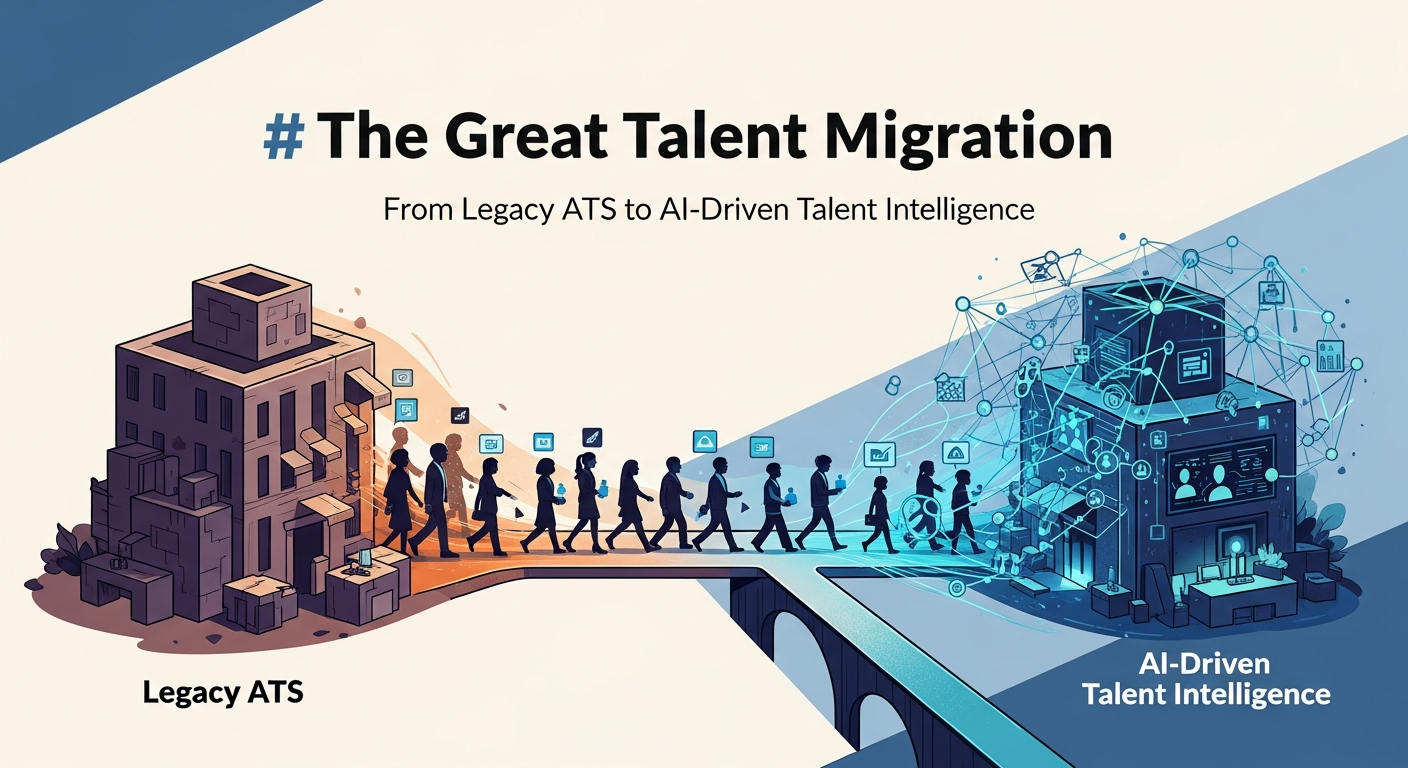
The Great Talent Migration: From Legacy ATS to AI-Driven Talent Intelligence
The global recruitment landscape is currently undergoing a seismic shift, characterized by a mass departure from legacy Applicant Tracking Systems (ATS) toward sophisticated, AI-enabled Talent Intelligence Platforms (TIP). This transition is not merely a routine software upgrade or a change in vendor; it represents a fundamental re-engineering of how human capital is identified, evaluated, and engaged in a digital-first economy. For decades, the “system of record” was the gold standard for HR departments, prioritizing compliance and administrative tracking. These traditional ATS platforms were effective at managing application workflows, storing resumes, and ensuring basic regulatory adherence. However, their limitations in proactively identifying, engaging, and developing talent have become glaringly apparent in a rapidly evolving job market.
The modern enterprise now demands a “system of intelligence”—one that can navigate the complexities of global talent shortages, persistent skills gaps, and the rapid acceleration of technological change. The advent of remote work, the gig economy, and the increasing demand for highly specialized skills have exposed the shortcomings of static, keyword-based systems. Organizations are no longer content with merely tracking applications; they need predictive insights and dynamic talent matching to stay competitive.
According to research into the latest trends in HR technology, the focus has decisively shifted from simple workflow automation to the strategic application of data science and artificial intelligence. As organizations struggle with “data graveyards”—vast repositories of fragmented, outdated, and unanalyzed candidate information—and fragmented candidate experiences, the migration to AI-driven recruitment has become a competitive necessity. This evolution is defined by five core trends: the integration of advanced Natural Language Processing (NLP) for contextual understanding, the rigorous harmonization of legacy data, a stringent focus on ethical AI and regulatory compliance, the crucial transition to skills-based hiring, and the deployment of Generative AI to personalize and enhance the candidate journey. This comprehensive overhaul fundamentally reshapes how companies attract, assess, and retain their most valuable asset: human talent.
Trend 1: The Transition from Keywords to Contextual Semantic Search
The migration from legacy ATS to AI-driven recruitment is fundamentally anchored in the transition from rigid keyword matching to advanced Natural Language Processing (NLP). Legacy systems, largely built on relational databases from the late 1990s and early 2000s, rely on Boolean strings and exact-match logic. This architectural constraint is increasingly viewed as a liability in a nuanced talent market. It creates a significant “false negative” problem where highly qualified candidates are overlooked simply because their terminology—or even a simple synonym—does not precisely match the recruiter’s specific query. For instance, a search for “Financial Analyst” might miss someone with “Financial Modeler” experience, despite identical core competencies. This rigidity leads to missed opportunities, prolonged time-to-hire, and an overwhelming manual screening burden on recruiters.
Semantic Parsing and Transformer Models
Modern AI-driven systems utilize sophisticated Transformer-based models, such as BERT (Bidirectional Encoder Representations from Transformers) and RoBERTa, to achieve “contextual search.” Unlike legacy parsers that read text linearly from left to right, often misinterpreting context, Transformers analyze the entire context of a sentence, paragraph, or even an entire resume simultaneously. This allows them to understand the true intent and meaning behind words. In a recruitment context, this capability is revolutionary: the system can recognize that a “Financial Controller” in a high-growth startup may possess the exact same competencies and experience as a “Senior Accounting Manager” in a Fortune 500 firm. It moves beyond superficial keywords to grasp the underlying skills, responsibilities, and impact of a candidate’s previous roles, significantly improving the precision and recall of talent searches. This deeper understanding ensures that valuable candidates are no longer filtered out due to semantic mismatches.
Vector Embeddings and Latent Semantic Indexing
The technical backbone of this trend is the creation of vector embeddings. Every candidate profile, resume, and job description is converted into a high-dimensional mathematical vector—a numerical representation that captures its semantic meaning. Within this intricate “vector space,” words and concepts with similar semantic meanings are placed in close proximity. Imagine a vast galaxy where skills like “Python,” “Data Science,” and “Machine Learning” are clustered together, while “Marketing” and “Sales” form different constellations. When a recruiter searches for a specific skill set or job requirement, the AI calculates the “cosine similarity” (the angle between the vectors) between the search intent and the candidate pool. This keyword-agnostic matching ensures that “latent semantic indexing” captures the true intent of the recruiter rather than just the literal syntax of the resume. This means a search for “problem-solving skills” will find candidates whose descriptions imply such skills, even if the exact phrase “problem-solving” isn’t present, but mentions “navigating complex projects” or “troubleshooting system failures.”
The Talent Graph and Ontological Mapping
Leading organizations are now moving toward “ontological mapping,” creating a dynamic “Talent Graph” that understands the deep, intricate relationships between skills, job titles, industries, and even certifications. For example, a robust Talent Graph knows that “Python” is not just a keyword but a sub-skill of “Data Science,” and is frequently associated with “Machine Learning,” “Statistical Analysis,” and “Big Data Processing.” This graph can also identify adjacent skills, showing that expertise in “Agile Project Management” is highly relevant for roles in “Product Development” or “Scrum Master” positions, even if the candidate hasn’t held that exact title. This sophisticated mapping allows for truly multilingual parsing where a resume written in German can be accurately matched against a job description in English based on underlying skill vectors, effectively eliminating the need for manual translation or restrictive local-language keyword lists. The Talent Graph continuously learns and evolves, reflecting the fluid nature of skill sets and job markets, providing a holistic and interconnected view of an organization’s talent ecosystem.
![IMAGE 1: A comparative visualization showing the difference between Legacy Keyword Matching (linear, missed connections) and AI Semantic Matching (network-based, identifying clusters of related skills and experiences). Alt text: Infographic contrasting linear, rigid keyword search of legacy ATS with network-based, contextual semantic search of AI talent intelligence platforms, highlighting how AI identifies related skills and experiences to find better matches.]
Trend 2: Data Harmonization and the ETL Framework for Migration
A critical hurdle in moving to AI-driven recruitment is the state of existing data. Legacy ATS platforms are often “data graveyards” filled with duplicate profiles, outdated contact information, inconsistent formatting, and a mix of structured and unstructured information that is difficult to parse. Entering 2024 and 2025, the focus is squarely on “Data Harmonization”—the intensive, meticulous process of cleaning, standardizing, enriching, and structuring information during the migration phase. The cost of “dirty data” is enormous, leading to wasted recruiter time, inaccurate reporting, compliance risks, and a poor candidate experience due to redundant outreach or incorrect information. This phase is not merely a technical chore but a strategic imperative to unlock the full potential of AI.
The Migration Lifecycle and ETL
The technical migration process utilizes advanced ETL (Extract, Transform, Load) frameworks specifically tuned for the unique complexities of HR data:
- Extraction: This initial phase involves systematically pulling vast amounts of unstructured data—ranging from years of PDFs, Word documents, and text files to even scanned images—from legacy relational databases, cloud storage, and even individual recruiter hard drives. Challenges include disparate data formats, varying data quality, and the sheer volume of historical records. Secure and efficient extraction methods are paramount to ensure data integrity and compliance.
- Transformation: This is where AI adds the most significant value and complexity. Unstructured data is “refactored” into structured, machine-readable formats. Data cleansing algorithms identify and correct “data debt,” such as decade-old contact information, defunct job titles, or inconsistent skill entries, flagging them for enrichment or removal. Deduplication algorithms use fuzzy matching and semantic analysis to identify and merge duplicate candidate profiles across different legacy systems, creating a single, comprehensive record. AI also standardizes data, mapping disparate job titles and skill terminologies to a unified ontology, preparing the data for advanced analytics and semantic search.
- Loading: The refined, harmonized data is then pushed into a “Recruitment Data Lake” or a cloud-native Talent Intelligence Platform. These modern architectures are designed for scalability, real-time querying by AI agents, and integration with other enterprise systems. The loading process ensures that data is stored in a format optimized for AI processing, allowing for rapid retrieval and analysis, which is crucial for dynamic talent matching and predictive analytics.
Metadata Enrichment and the “Golden Record”
Modern migration strategies prioritize “metadata enrichment.” During the migration, an AI layer can scan a candidate’s historical profile and automatically update their current skills, job titles, and contact information by cross-referencing public professional profiles (like LinkedIn), social data, or other validated external sources. This real-time validation and augmentation are critical. The ultimate outcome of this rigorous process is the “Golden Record”—a single, unified, and continuously enriched profile that serves as the “source of truth” for the organization’s entire talent pool. By meticulously resolving duplicates and merging fragmented records from different regional ATS instances, companies can finally achieve a 360-degree view of their internal and external talent, enabling more informed decision-making and a consistent candidate experience.
API-First Architecture
To avoid the trap of creating new data silos, organizations are prioritizing “API-first architecture” in their new Talent Intelligence Platforms. This design philosophy ensures that the newly migrated and continuously updated talent data remains fluid and accessible across the enterprise. The AI system can seamlessly pull and push data to other essential Human Resource Information Systems (HRIS), payroll platforms, Learning Management Systems (LMS), and even performance management tools in real-time. This interoperability creates a cohesive, integrated HR technology ecosystem where recruitment data actively informs workforce planning, internal development, succession planning, and overall talent strategy. This level of integration is paramount for truly unlocking the strategic value of human capital data, moving beyond siloed functions to a unified, intelligent talent ecosystem.
![IMAGE 2: A technical flowchart of the Migration Lifecycle, moving from ‘Legacy Extraction’ through ‘AI Data Cleansing/Enrichment’ to ‘Unified Talent Intelligence Platform Deployment’. Alt text: Flowchart illustrating the data migration process: Legacy Extraction, followed by AI Data Cleansing, Data Harmonization, Metadata Enrichment, and finally Unified Talent Intelligence Platform Deployment, showcasing the transformation of raw data into actionable insights.]
Trend 3: Ethical AI, Bias Mitigation, and Regulatory Compliance
As companies migrate to AI-driven recruitment, the focus on ethical implications and regulatory compliance has transitioned from a niche concern to a top-tier corporate priority. The transition from manual human review to automated algorithmic screening brings significant legal, reputational, and ethical risks if not managed carefully. Unchecked AI can perpetuate and even amplify historical biases present in training data, leading to discriminatory hiring practices and damaging public trust. Global regulators are taking note, with the emergence of rigorous regulatory frameworks for AI such as the EU AI Act and New York City’s Local Law 144. These regulations mandate transparency, fairness, and accountability for high-risk AI systems, including those used in employment decisions. The proactive implementation of ethical AI principles is no longer optional but a legal and moral imperative. For a deeper dive into these considerations, explore our article on AI in Recruitment: Ethical Sourcing & Predictive Analytics.
Explainable AI (XAI) and Algorithmic Transparency
A major shift is occurring toward “Explainable AI” (XAI). In legacy systems and early AI models, the “black box” nature of algorithms meant that if a candidate was rejected, there was often no clear, auditable trail explaining why. This lack of transparency fostered distrust and presented significant compliance challenges. XAI provides a clear, human-readable rationale for ranking and scoring decisions. For instance, a recruiter can see a justification such as: “Candidate ranked in the top 10% due to 7 years of specialized cybersecurity experience, a recent certification in AWS Architecture, and demonstrated leadership in open-source projects, matching 94% of the core job requirements.” This transparency is essential for several reasons: it builds trust with candidates and hiring managers, facilitates internal audits, allows for continuous model improvement, and provides critical documentation for regulatory compliance, ensuring that decisions are fair, objective, and defensible.
Bias Audits and Adverse Impact Analysis
Organizations are now mandated to conduct regular and thorough “bias audits” of their AI recruitment tools. This involves “adverse impact analysis,” a statistical methodology where the AI’s performance is mathematically tested across different demographic groups to ensure no “protected class” (e.g., based on gender, race, age, or disability) is being unfairly disadvantaged. The goal is to adhere to the “four-fifths rule,” which generally indicates adverse impact if the selection rate for a protected group is less than 80% of the selection rate for the group with the highest rate. During the migration process, “bias detection algorithms” are deployed to “de-bias” historical data. If past human hiring managers were consistently biased against candidates from certain non-traditional backgrounds or demographics, the AI is explicitly trained to ignore those historical patterns in favor of objective, meritocratic hiring criteria, preventing the perpetuation of past inequities. This involves sophisticated techniques such as re-weighting biased features, training on debiased datasets, or implementing fairness-aware machine learning algorithms.
Anonymized Screening Protocols
To further Diversity, Equity, and Inclusion (DEI) goals and mitigate unconscious human bias, AI-driven platforms are implementing advanced “anonymized screening” protocols. During the initial evaluation phase, the AI evaluates candidates based solely on skills, certifications, relevant experience, and objective qualifications, while stripping away personal identifiers such as names, photos, gender markers, age-related data, and even addresses that might reveal socioeconomic background. This ensures a truly level playing field, allowing the most qualified candidates to surface based purely on their capabilities, regardless of unconscious biases that might be triggered by demographic information. Recruiters gain access to this anonymized data during initial screening, fostering a more equitable process. Only after a curated shortlist is established are identifying details revealed, minimizing the potential for human bias in the early stages of the hiring funnel. This approach demonstrably improves diversity outcomes and reinforces an organization’s commitment to fair hiring practices.
![IMAGE 4: An ‘Ethical AI Scorecard’ graphic showing how modern recruitment platforms track and report on metrics such as Adverse Impact Ratio and Model Transparency. Alt text: Graphic of an ‘Ethical AI Scorecard’ dashboard, displaying key metrics like Adverse Impact Ratio, Model Transparency, Bias Detection, and Fairness Metrics, indicating an AI system’s compliance with ethical guidelines in recruitment.]
Trend 4: Transitioning from Job-Based to Skills-Based Hiring
One of the most profound shifts in the migration from legacy ATS to AI-driven systems is the fundamental move from “job-based” hiring to “skills-based” hiring. Legacy systems are inherently rigid; they are built around the concept of a static “Job Opening” defined by a specific title and a “Candidate” linked to that title. This often pigeonholes talent, limits internal mobility, and fails to adapt to the dynamic nature of modern roles. AI-driven recruitment, however, treats the organization and the candidate pool as a dynamic, fluid ecosystem of skills. This paradigm shift acknowledges that a person’s capabilities are far more indicative of their potential and suitability than a fixed job title.
The Skills Graph and Adjacent Skills
This transition involves the intricate creation and continuous evolution of a “Skills Graph.” This advanced ontological mapping identifies not just a candidate’s primary skills, but also “adjacent skills”—those closely related or transferable capabilities that might not be explicitly listed but are highly relevant. For example, a candidate with deep “Data Analysis” experience might easily pivot to “Business Intelligence” or “Product Growth” roles even if they have never held those specific titles. The AI identifies these overlaps by analyzing vast datasets of successful career transitions, skill taxonomies, and industry trends, creating a comprehensive map of how skills interconnect. This enables powerful “talent rediscovery”—the ability to find existing candidates in the database who were previously rejected for one role (perhaps a narrowly defined job-based search) but possess the perfect, often overlooked, skill set for a current, different opening. This maximizes the return on investment in past recruiting efforts and significantly expands the accessible talent pool.
Internal Mobility and Workforce Planning
Skills-based hiring is a primary, indispensable driver of “internal mobility” and strategic workforce planning. By meticulously mapping the “skill taxonomy” of the existing workforce, AI can proactively suggest current employees for new roles, projects, or developmental opportunities. This capability significantly reduces cost-per-hire by prioritizing internal talent, accelerates time-to-fill, and dramatically increases employee retention by demonstrating clear career paths. This is vital for “reskilling” and “upskilling” initiatives, which are critical for future-proofing an organization. According to the foundational workforce statistics provided by the World Economic Forum, nearly half of workers’ core skills will need to change by 2027. AI helps identify employees with the foundational aptitude and adjacent skills to move into emerging fields like AI ethics, sustainability, or cloud engineering before those skill gaps become critical. It allows organizations to predict future talent needs based on strategic business objectives and market trends, transforming reactive hiring into proactive talent development. This forward-looking approach ensures the workforce is agile and adaptable to future challenges. For more insights on this, refer to our analysis of AI in Recruitment: The Future of Hiring Trends for 2025.
![IMAGE 3: A ‘Skills Map’ visualization illustrating how a single candidate profile connects to multiple potential roles based on skill overlap rather than job titles. Alt text: ‘Skills Map’ diagram showing a central candidate profile connected by lines to various job roles (e.g., Data Scientist, Business Analyst, Product Manager), illustrating how AI identifies skill overlaps to suggest multiple potential career paths beyond traditional job titles.]
Trend 5: Generative AI and the Hyper-Personalized Candidate Experience
The final major trend in the migration to AI-driven recruitment is the transformative use of Generative AI to overhaul the candidate experience. Legacy ATS systems are notorious for the “black hole” effect, where candidates submit applications and often never receive feedback, updates, or even an acknowledgment beyond an automated email. This leads to frustrated candidates, a damaged employer brand, and a significant drop-off in engagement. AI-driven recruitment solves this through “hyper-personalization,” treating candidates more like valuable customers in a marketing funnel than anonymous names in a database. This shift fosters a positive brand image and improves candidate satisfaction and conversion rates.
Conversational AI and Automated Engagement
“Conversational AI” and sophisticated recruitment chatbots now provide 24/7 engagement, ensuring candidates always have a point of contact. These intelligent agents can answer complex questions about company culture, specific benefits, interview processes, and application status instantly, at any time of day, across multiple channels (website, messaging apps). This significantly reduces the burden on recruiters for routine inquiries. Furthermore, “automated outreach” tools leverage Large Language Models (LLMs) to craft highly personalized and contextually relevant messages to passive candidates. Instead of a generic “We have a job you might like” email, the AI can reference a specific project a candidate worked on, a unique combination of skills in their profile, a recent certification, or even shared connections. This level of personalization, generated dynamically by AI, has been shown to significantly increase response and engagement rates, transforming cold outreach into meaningful conversations.
Job Description Optimization and Sentiment Analysis
Generative AI is also being utilized for “job description optimization,” playing a crucial role in attracting a diverse and high-quality candidate pool. It can scan job postings for gender-coded language (e.g., “ninja,” “rockstar”), unnecessary jargon, or exclusionary phrasing that might inadvertently alienate certain demographics or discourage qualified applicants. The AI can then suggest more inclusive, neutral, and engaging language, improving the breadth and quality of applicants. Additionally, “candidate sentiment analysis” allows recruiters to monitor feedback throughout the entire interview process. By analyzing textual data from candidate surveys, chatbot interactions, and open-ended feedback, the AI can detect patterns of confusion, friction, or negative sentiment at specific stages—such as a particularly complex technical assessment, a lengthy interview process, or issues with a background check provider. The AI flags these bottlenecks for the recruiting team, allowing them to address issues immediately, refine their processes, and ensure a consistently positive candidate journey. This continuous feedback loop is critical for iterative improvement and maintaining a strong employer brand in a competitive talent market.
![IMAGE 5: An infographic depicting the ‘AI-Enhanced Candidate Journey,’ from the first touchpoint with a chatbot to the final automated interview scheduling, emphasizing speed and personalization. Alt text: Infographic illustrating the ‘AI-Enhanced Candidate Journey’ flow, showing personalized candidate interactions at each stage: AI chatbot for initial queries, AI-driven job matching, automated interview scheduling, and personalized feedback, highlighting speed and engagement.]
Economic and Operational Impact Analysis
The shift toward AI-driven recruitment is not just a technological upgrade; it is backed by significant economic data that underscores why enterprises are willing to invest in such complex and transformative migrations. The operational efficiencies and strategic advantages gained are substantial, making the investment in AI-driven Talent Intelligence Platforms a clear differentiator in the global war for talent.
- Efficiency Gains: Industry benchmarks from leading research firms like Deloitte and Gartner indicate that organizations migrating to AI-driven semantic search and automation report a remarkable 30% to 50% reduction in “Time-to-Fill” for technical and specialized roles. This substantial improvement is primarily attributed to the elimination of manual resume screening, which previously consumed up to 60% of a recruiter’s time, diverting focus from strategic candidate engagement. AI automates routine tasks such as resume parsing, initial candidate ranking, and even interview scheduling, freeing recruiters to focus on building relationships and making critical hiring decisions.
- The Cost of “Dirty Data”: Research from IBM indicates that poor data quality costs the global economy trillions of dollars annually. In the context of recruitment, “data debt” manifests as lost opportunities, inefficient processes, and compliance risks. When 40-60% of legacy records are duplicates, obsolete, or inaccurate, recruiters are essentially flying blind, wasting time on invalid leads or missing out on qualified candidates hidden within their own databases. AI migration directly addresses this by providing a clean, actionable, and continuously updated dataset, which improves decision-making, reduces redundant efforts, and unlocks the full potential of an organization’s talent pool.
- The Retention Factor: By proactively utilizing AI for internal mobility and skills mapping, companies can see a marked increase in employee retention rates. When employees perceive a clear path for growth, reskilling, and advancement within the organization—based on their evolving skills and potential rather than just their current job title—they are far more likely to stay. This strategic use of AI fosters a culture of continuous learning and development, significantly reducing the high costs associated with employee turnover, including recruitment, onboarding, and lost productivity.
- Regulatory Compliance Costs: With the increasing enforcement of regulations like the EU AI Act, recruitment software is categorized as a “High-Risk AI System.” This means compliance is no longer optional but a legal necessity with significant repercussions. The cost of non-compliance—including hefty fines up to 7% of global annual turnover, reputational damage, and legal battles—far outweighs the cost of migrating to a modern, transparent, and auditable Talent Intelligence Platform. These platforms are designed with explainable AI, bias mitigation, and robust audit trails, offering peace of mind and operational security in an increasingly regulated AI landscape.
Technical Pillars of the Modern Talent Platform
To successfully navigate this complex migration and fully leverage the benefits of AI in recruitment, HR and IT leaders are focusing on several key technical pillars that fundamentally distinguish Talent Intelligence Platforms from their legacy predecessors:
- Vector Databases (e.g., Pinecone, Milvus): These specialized databases are indispensable for storing and efficiently querying the high-dimensional vector embeddings of candidate profiles, resumes, and job descriptions. Unlike traditional relational databases, vector databases are optimized for similarity searches, enabling the sub-second search speeds required for semantic matching across vast talent pools. They are the engine behind the ability to find “similar” candidates, not just “exact matches.”
- Named Entity Recognition (NER): A highly specialized sub-task of Natural Language Processing (NLP), NER is crucial for structuring unstructured text. It automatically identifies and extracts specific entities such as “University Name,” “Years of Experience,” “Programming Languages,” “Certifications,” “Company Names,” and “Job Titles” from raw text with remarkable precision. This extracted, structured data then feeds into the candidate’s “Golden Record” and the comprehensive Skills Graph, making the information usable for AI analytics.
- Knowledge Graphs: These represent the complex, non-linear relationships between “Skills,” “Certifications,” “Job Roles,” “Industries,” and “Competencies” in a semantic network. Unlike simple databases, knowledge graphs allow the AI to make “logical leaps” and infer connections that are not explicitly stated. For example, realizing that a candidate with ‘Project Management’ skills in construction might have highly transferable ‘Operations Management’ skills relevant to logistics, or that ‘TensorFlow’ is a framework for ‘Machine Learning’ which is a type of ‘Artificial Intelligence.’
- Adverse Impact Ratio (AIR): This has become a standard, critical metric in bias audits for AI recruitment systems. AIR quantifies fairness by comparing the selection rate of a protected group to that of the most favored group. It ensures that the selection rate of a protected group is at least 80% (the “four-fifths rule”) of the selection rate of the group with the highest rate, thereby meeting legal requirements for non-discriminatory hiring. Modern platforms incorporate automated AIR calculation and continuous monitoring to ensure ongoing compliance and ethical performance.
Future Outlook: The Rise of the Talent Intelligence Platform (TIP)
The ultimate goal of this sweeping migration is the establishment of a “Talent Intelligence Platform” (TIP). Unlike the legacy ATS, which was merely a “system of record” primarily for compliance and administrative tracking, the TIP is a “system of intelligence.” It leverages the combined power of advanced NLP, meticulous data harmonization, ethical AI, dynamic skills-mapping, and innovative Generative AI to provide a holistic, predictive, and agile view of the entire talent landscape.
This evolution enables truly “Predictive Workforce Planning.” Instead of reactively scrambling to fill a vacancy, the AI can forecast future talent shortages based on macro-market trends (e.g., economic shifts, technological advancements), internal attrition rates, and the company’s strategic growth goals. This allows HR and recruiting teams to proactively build talent pipelines months, or even years, before a “Job Requisition” is officially opened. The TIP facilitates proactive talent development, identifying current employees who can be upskilled or reskilled to meet future demands, fostering a resilient and adaptable workforce.
The migration from legacy systems is thus not just an IT project or a departmental initiative; it is the first critical step in a broader digital transformation of the human capital function itself. It represents a fundamental shift from administrative HR to strategic HR, where talent acquisition becomes a data-driven, intelligent, and continuously optimizing process. As the boundary between “technology” and “talent” continues to blur, the organizations that successfully migrate to and master these intelligent systems will be the ones that not only win the global war for talent but also define the future of work.


One Response
[…] represents a fundamental paradigm shift in recruitment technology. This industry-wide move from legacy ATS to AI-driven talent intelligence: the great migration addresses the flaws of traditional methods. For decades, keyword matching relied on exact text […]