
Beyond the Org Chart: How HR Must Redesign Work to Unlock Business Value
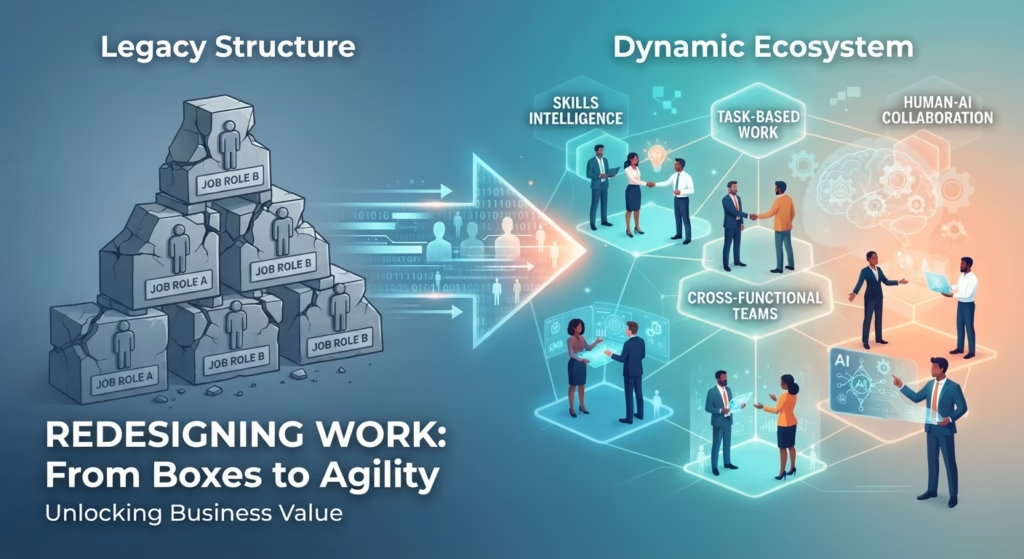
For decades, human resources operated within a predictable paradigm: define a rigid job description, slot an individual into a hierarchical box on an organizational chart, and manage performance through standardized annual cycles.
In his insightful article, “How HR Should Redesign Work to Unlock Business Value,” global people analytics leader David Green argues that this industrial-era model has reached its expiration date. Between the rapid surge of artificial intelligence, shifting demographics, and mounting executive pressure to demonstrate measurable productivity, the traditional concept of a “job” is breaking down.
If organizations hope to capture true business impact, HR must transition from being a reactive administrator of workforce processes to the architect of a dynamic, value-driven work ecosystem.
Here is an analysis of why work redesign has become the defining agenda for modern HR—and how leaders can turn that vision into measurable enterprise value.
1. Deconstructing the “Job” into Tasks and Skills
At the heart of modern work redesign is a fundamental pivot: moving away from fixed job roles and toward the deconstruction of work into underlying tasks and capabilities.
When a company views work strictly through the lens of static job titles, it creates organizational friction. Skills get trapped within functional silos, talent mobility grinds to a halt, and leaders struggle to reallocate resources when market conditions change.
By breaking roles down into discrete tasks, organizations can evaluate:
- Which tasks can be automated or accelerated by technology?
- Which tasks require high-touch human judgment, creativity, or empathy?
- What specific skills are needed to execute those high-value tasks?
This skills- and task-based approach liberates talent, allowing organizations to deploy individuals dynamically to cross-functional projects where their unique capabilities deliver the highest return.
2. Orchestrating the Human-AI Operating System
Many organizations have spent recent quarters encouraging grassroots AI experimentation. While adoption numbers may look high, widespread experimentation does not automatically translate into bottom-line productivity.
As Green highlights in his LinkedIn Pulse analysis, the next phase of enterprise transformation requires designing an integrated Human-AI Operating System. This is not an IT project; it is an organizational design imperative:
- Task Allocation: Clarifying whether work is human-led, machine-automated, or augmented through human-AI collaboration.
- Decision Rights and Escalation: Defining where AI recommendations require human sign-off, ethical review, or governance checkpoints.
- Amplification over Displacement: Leveraging technology to absorb routine cognitive labor so workers can focus on high-impact strategic and interpersonal work.
When HR steps up to orchestrate this interface, AI transitions from an isolated productivity hack into a cohesive operational engine.
3. Designing for Multi-Stage Careers and the 100-Year Life
Work redesign is not only driven by software; it is also driven by demographics. Drawing on concepts popularized by Lynda Gratton and Andrew Scott in The 100-Year Life, Green emphasizes that linear, three-stage career paths (education employment retirement) are no longer aligned with longer, multi-stage working lives.
Employees now navigate repeated transitions across their careers, requiring periods of reskilling, flexible working models, and lateral career mobility. Organizations that cling to rigid career ladders risk losing seasoned talent and alienating younger workers seeking continuous growth. By building modular career architectures, HR enables workers at every career stage to reinvent themselves without leaving the enterprise.
4. Shifting from HR Processes to Strategic Products
Historically, HR measured success through process compliance: completion rates of annual appraisals, training attendance, or policy rollouts. To unlock genuine business value, HR must adopt a product mindset:
- Focus on Business Outcomes: Design talent solutions that directly solve frontline bottlenecks—such as reducing time-to-productivity, enhancing engineering throughput, or improving customer retention.
- User-Centric Architecture: Treat employees and managers as internal users, designing frictionless workflows rather than burdening them with bureaucratic tools.
- Shared Ownership: HR provides the framework, data, and governance, but business executives (COOs, division heads) must co-own the workforce transformation.
5. Grounding Transformation in People Analytics
You cannot redesign what you cannot measure. A data-driven approach to people analytics is the foundation that makes work redesign possible:
- Skills Intelligence: Mapping existing skills versus adjacent capabilities to identify emerging capability gaps before they become critical liabilities.
- Organizational Network Analysis (ONA): Understanding how collaboration actually happens across teams rather than relying on the lines drawn on an org chart.
- Workload and Friction Mapping: Identifying administrative drag that drains employee capacity and fuels burnout.
By grounding talent strategies in hard evidence, HR leaders earn a seat at the executive table, presenting data-backed workforce investments directly tied to organizational performance.
Where Leaders Should Begin
For HR leaders looking to put these principles into practice, start small but think systematically:
- Audit a Single Workflow: Select a critical business unit (e.g., customer operations or product engineering) and deconstruct its core workflows into discrete tasks rather than job specs.
- Clarify the Human-Machine Boundary: For each task, pinpoint where automation handles repetitive steps and where critical human judgment must be reinforced.
- Remove Process Friction: Eliminate administrative HR steps that do not directly improve team agility or employee engagement.
- Partner with Business Leaders on KPIs: Define clear operational metrics with business unit leads so workforce redesign is tracked by business outcomes, not HR vanity metrics.
The Bottom Line
Redesigning work is no longer an intellectual exercise for the future—it is a current operational necessity. As David Green illustrates in his full article, the organizations that flourish in the coming decade will not simply be those that buy the newest tools or hire the fastest. They will be the ones whose HR leaders possess the courage to deconstruct legacy structures and build an adaptable, human-centered work operating model designed for lasting business value.