BambooHR vs. Workable: Best Small Business ATS in 2026
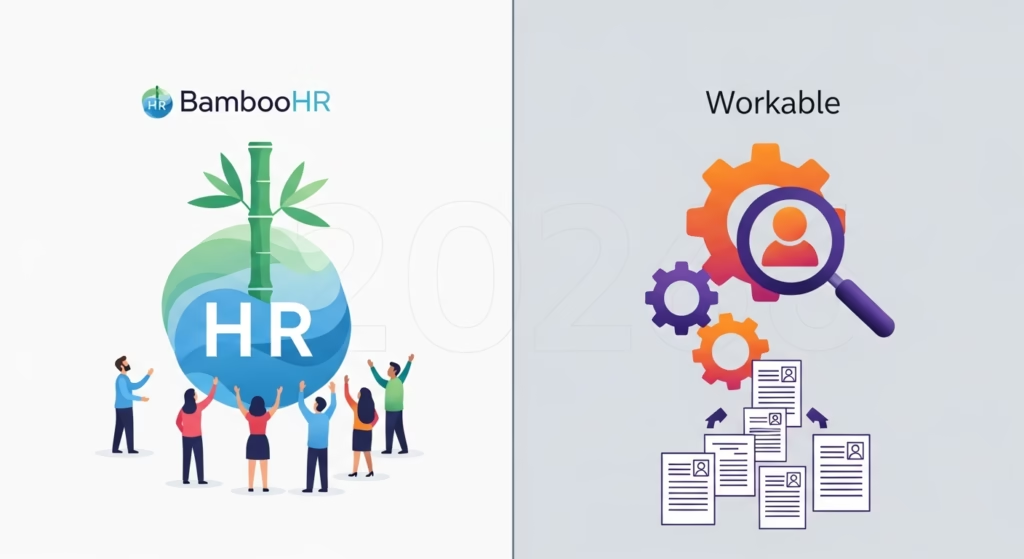
BambooHR vs. Workable: Which is Better for Small Businesses in 2026?
The recruitment and human resources landscape for small businesses (SMBs) has undergone a seismic shift as we move through 2026. The “Skills Economy” has fully matured, and the competition for niche talent is no longer restricted by geography. For the modern small business, the choice between an all-in-one Human Resources Information System (HRIS) with recruitment capabilities and a dedicated Applicant Tracking System (ATS) has never been more critical.
In this arena, two titans remain the primary contenders: BambooHR and Workable. While both have integrated advanced Generative AI and predictive analytics into their cores, they serve fundamentally different strategic needs. Understanding how AI & Data: Redefining Talent Acquisition & Recruitment impacts your bottom line is the first step in making an informed decision. This guide provides a deep-dive analysis into which platform will provide the highest ROI for your small business in 2026.
The State of SMB Recruitment in 2026
To understand the value of these platforms, we must look at the current market dynamics. Small businesses today are dealing with three primary challenges:
- AI-Saturated Pipelines: High volumes of AI-generated resumes require sophisticated automated screening to identify genuine talent.
- Fractional Hiring: A rise in part-time, contract, and “fractional” leadership roles necessitates flexible hiring workflows.
- Retention as Recruitment: The realization that effective onboarding and internal mobility are the most cost-effective ways to “hire.”
BambooHR has leaned into the “Employee Experience” (EX) angle, while Workable has doubled down on “Recruitment Intelligence” (RI). When evaluating these tools, business owners often look to G2’s Best Applicant Tracking Systems for 2026 Rankings to see how peer reviews stack up against marketing promises.

BambooHR: The “Heart of HR” Strategy
BambooHR has spent the last decade evolving from a simple database into a comprehensive “people platform.” For a small business in 2026, BambooHR is designed to be the single source of truth from the moment a candidate applies until the day they retire. It consistently appears on the Capterra shortlist for the best HR management software due to its user-friendly interface and holistic approach.
Core Strengths in 2026
1. Unified Data Ecosystem
The primary advantage of BambooHR is integration. When you hire a candidate through their ATS, the data flows seamlessly into payroll, benefits, time tracking, and performance management. In 2026, this eliminates the “data fragmentation” that plagues small teams who don’t have dedicated HR IT staff. You aren’t just buying an ATS; you are buying an entire back-office infrastructure.
2. Predictive Retention Analytics
BambooHR’s 2026 update introduced “Retention AI.” By analyzing engagement surveys, time-off patterns, and performance milestones, the system alerts managers to “flight risks” before they quit. For an SMB, where losing one key employee can stall a project, this is invaluable. The software uses sentiment analysis on internal feedback to give leadership a “cultural pulse” that was previously only available to enterprise-level firms.
3. The “Onboarding Orchestrator”
BambooHR remains the industry leader in the transition from candidate to employee. Their automated onboarding workflows handle digital signatures, equipment provisioning, and “culture drip” emails that introduce the new hire to the team dynamically. To truly leverage these features, many businesses seek advice on how to automate onboarding using HR tools to ensure a frictionless transition. In 2026, where remote work is the standard, this digital “welcome mat” is the difference between a new hire feeling connected or isolated.
The Evolution of BambooHR’s ATS
While historically considered a “light” ATS, the 2026 version of BambooHR has integrated smarter filtering. It now uses Natural Language Processing (NLP) to match candidate skills with internal job descriptions, significantly reducing the manual labor of resume reviews. However, it still lacks the aggressive outbound sourcing tools found in Workable.
Workable: The “Recruitment Powerhouse” Strategy
Workable has maintained its lead by focusing intensely on the “top of the funnel.” In 2026, recruitment is no longer about posting a job and waiting; it is about proactive sourcing. Workable is built for companies that are in a high-growth phase and need to compete with enterprise giants for talent.
Core Strengths in 2026
1. Autonomous Sourcing (AI-Sourcing 3.0)
Workable’s standout feature in 2026 is its autonomous sourcing engine. It doesn’t just post to job boards; it scans millions of public profiles (LinkedIn, GitHub, Behance) to identify “passive” candidates. Its AI then crafts personalized outreach emails that have a 40% higher response rate than standard templates. For a small business without a dedicated recruiter, Workable acts as a virtual headhunter.
2. Video Interviewing and Async Assessments
Workable fully integrated native video interviewing and AI-graded skills assessments into its platform. This allows small businesses to screen hundreds of candidates without a single live phone screen, significantly reducing the “time-to-hire” metric. By 2026, the platform’s AI can even provide “bias-alerts,” flagging if a hiring manager’s feedback seems to deviate from objective scoring criteria.
3. Global Compliance and Employer of Record (EOR) Links
Recognizing that 2026 SMBs hire globally, Workable has built-in compliance checks for over 50 countries. It integrates directly with EOR services, making it easier to hire a developer in Estonia or a designer in Brazil without setting up a local legal entity. This global-first approach is why many scaling startups prefer it over localized HRIS systems.
The Limitations of Workable
Workable is not an HRIS. While it has added some basic onboarding features, it lacks the deep employee management, payroll, and benefits administration that BambooHR provides. If you use Workable, you will likely need a secondary platform to manage your employees after they are hired.

Technical Deep Dive: AI and Automation in 2026
The real battleground in 2026 is Artificial Intelligence. According to the Gartner Magic Quadrant for Cloud HCM Suites, the gap between platforms that use AI for automation and those that use it for prediction is widening.
BambooHR’s AI: The “Nurturer”
BambooHR uses AI to improve the quality of life for existing employees.
* Auto-Scheduler: AI looks at team availability and candidate time zones to find the perfect interview slot without a single email back-and-forth.
* Sentiment Analysis: It scans anonymous employee feedback to tell you why people are unhappy, not just that they are.
* Career Pathing: The AI suggests internal moves for employees based on their growing skill sets, helping with long-term retention.
Workable’s AI: The “Hunter”
Workable uses AI to improve the speed of acquisition.
* Candidate Ranking: Instead of just keyword matching, Workable’s AI understands “career trajectory.” It knows that a “Junior Designer” at a top-tier firm might be ready for a “Senior Role” at your SMB.
* Automated Outreach: It creates multi-touch email sequences that stop once a candidate responds, mimicking a human recruiter.
* Interview Intelligence: It can transcribe and summarize interviews, highlighting the candidate’s answers to specific “must-have” skill questions.
Feature-by-Feature Comparison for 2026
| Feature | BambooHR (2026) | Workable (2026) |
|---|---|---|
| Core Philosophy | HRIS with an ATS “wing.” | ATS with an Onboarding “wing.” |
| Sourcing | Strong job board distribution. | Elite AI-driven passive candidate sourcing. |
| AI Screening | Focuses on culture fit and resume parsing. | Focuses on skills-gap analysis and predictive performance. |
| User Interface | Warm, intuitive, “People-First” design. | Sleek, fast, “Recruiter-First” design. |
| Onboarding | Industry-leading; includes task management. | Basic; focuses on document signing. |
| Global Hiring | Limited; mostly focused on US/Canada/UK. | Excellent; built-in global compliance tools. |
| Reporting | Deep “People Analytics” (turnover, EEO). | Deep “Hiring Analytics” (cost-per-hire, pipeline). |
| Integrations | Strong ecosystem; best with Bamboo Payroll. | Open API; integrates with 200+ third-party tools. |
The Cost Factor: Budgeting for 2026
Pricing models have shifted toward “Value-Based” tiers in 2026, moving away from the rigid flat fees of the early 2020s.
BambooHR Pricing Logic:
BambooHR typically uses a per-employee-per-month (PEPM) model. This is highly predictable for stable companies. If you have 30 employees, you know exactly what your bill is every month. However, because it is an all-in-one system, you are paying for the HRIS, the ATS, and the performance modules combined. For a small business with 20 employees, the cost can range from $150 to $400 per month depending on the “Advantage” vs. “Essentials” tiers.
Workable Pricing Logic:
Workable offers more flexibility for companies that hire in bursts. Their “Pay-as-you-go” model ($149/job/month) is perfect for a company that only hires twice a year. However, their “Standard” and “Premier” plans for high-growth firms are significantly more expensive than BambooHR. You are paying for the technology that finds candidates you couldn’t find otherwise. If Workable saves you one $10,000 recruiter fee, it has paid for itself for two years.

User Experience: Recruiter vs. Employee
In 2026, the “User Experience” (UX) isn’t just for the person buying the software—it’s for the candidates and the staff.
The Candidate Experience:
Workable offers a slightly more frictionless application process. In 2026, this includes “one-tap” applications from social media profiles and a mobile-first interface that feels like a consumer app. BambooHR’s application process is professional and clear but often requires more manual data entry from the candidate if they aren’t using a standard resume format.
The Manager Experience:
Hiring managers often prefer Workable because of its “Hiring Workspace.” It looks like a Trello board for people. You can drag and drop candidates through stages, leave voice-note feedback for colleagues, and see an AI-generated summary of why a candidate was ranked 4 out of 5 stars.
The Employee Experience:
BambooHR wins this category hands-down. Once the hiring is done, employees use the BambooHR mobile app for everything: requesting time off, looking up a colleague’s birthday, viewing their latest performance review, and checking their benefits. In 2026, the BambooHR app is often the most-used business app on an employee’s phone after Slack or Teams.
Security, Privacy, and Data Governance
In 2026, data sovereignty is a top priority. Both platforms have upgraded their security protocols to meet evolving global standards like GDPR 2.0 and the AI Act.
BambooHR prioritizes internal data security. Since it houses sensitive employee information—social security numbers, bank details, and health records—it uses bank-grade encryption and multi-factor biometric authentication. For a small business owner, this provides peace of mind that their core business data is shielded from breaches.
Workable, meanwhile, focuses on candidate data privacy. With its AI scanning public profiles, it must ensure that it complies with “Right to be Forgotten” requests across various jurisdictions. Their 2026 platform includes an automated privacy dashboard where candidates can manage their data across all companies using Workable, reducing the legal liability for the small business hiring them.
Implementation: What to Expect in Year One
Choosing a platform is only half the battle; implementation determines your success.
BambooHR Implementation:
Setting up BambooHR is a foundational project. It typically takes 4 to 8 weeks to migrate data, set up approval workflows, and train the team. BambooHR provides dedicated implementation specialists for their Advantage tier, which is essential for SMBs moving away from manual spreadsheets for the first time.
Workable Implementation:
Workable is famously fast to deploy. A small business can post its first job within 24 hours of signing up. The complexity only arises when integrating with existing HRIS or payroll systems. If you are using Workable as a standalone “hiring engine,” the learning curve is remarkably shallow, making it ideal for teams that need to start hiring immediately.
Strategic Selection: Which One Should You Choose?
The decision between BambooHR and Workable in 2026 comes down to your primary pain point.
Choose BambooHR if:
- Your administrative burden is too high. If you are currently using spreadsheets for PTO and paper files for employee records, BambooHR will transform your business.
- You have a low turnover/low hiring rate. If you only hire 2–3 people a year but want those people to have a world-class experience from day one, BambooHR is the right fit.
- You want a “Single Source of Truth.” You want one login for everything related to your people, from their first interview to their final paycheck.
- Culture is your differentiator. You need the engagement surveys and “Recognition” features to keep your team motivated.
Choose Workable if:
- You are in a “War for Talent.” If you are a tech startup, a specialized agency, or a high-growth firm that needs to hire 10+ people a year in a competitive niche, Workable’s sourcing AI is a necessity.
- You hire internationally. You need the built-in compliance and global job board reach that a localized HRIS cannot provide.
- You already have an HRIS you like. If you are already happy with your payroll and employee records, don’t switch everything just for an ATS. Add Workable as your specialized “hiring engine.”
- You need speed. If your current “time-to-hire” is over 45 days and it’s hurting your revenue, Workable’s automation will likely cut that number in half.
The 2026 SMB Advantage: Conclusion
As we look toward the remainder of 2026 and into 2027, the gap between “having a team” and “managing a workforce” is closing. Small businesses no longer have the luxury of slow, manual HR processes. The “Big Two”—BambooHR and Workable—have both risen to the challenge by democratizing enterprise-grade AI for companies with fewer than 100 employees.
If your goal is to build a fortress of stability and employee satisfaction, BambooHR is your foundation. It treats the employee as a long-term asset to be nurtured. If your goal is to build a rocket ship of growth and talent acquisition, Workable is your fuel. It treats recruitment as a precision engineering challenge that can be solved with superior data and outreach. Regardless of your choice, the integration of these platforms into your daily workflow is no longer optional. In the 2026 economy, the business with the best people wins—and the business with the best tools finds the best people.