The 2026 HR Strategic Mandate: Governing Agentic Autonomy and Engineering the Human Workplace
I. Strategic Overview: The Human-Centric Correction in the Age of Autonomy
The human resources landscape in 2026 is defined by a critical strategic pivot: the shift from the eager adoption of new digital tools to the sophisticated, ethical governance of autonomous systems. This transition, coupled with a fragile global economy and continuous AI integration, compels Chief Human Resources Officers (CHROs) to fundamentally re-evaluate their talent strategies.[1] The primary mandate for the modern HR function is no longer merely supporting business operations, but actively mobilizing leaders and shaping the work environment for the emerging human-machine era.[2]
A. The 2026 Strategic Pivot: From Adoption to Governance
The velocity of technological change dictates that organizations move past rudimentary AI applications. Consulting forecasts confirm that 2026 will see accelerated shifts in business software, making applications smarter, more personalized, adaptive, and autonomous.[3] These Agentic AI systems are expected to move beyond pilot projects and become more widely adopted across industries, particularly within large organizations possessing the necessary capital and talent.[4] This rapid, widespread deployment of autonomous systems, which act as digital coworkers capable of executing complex workflows [5], creates an immediate governance crisis. HR must establish ethical guardrails and accountability mechanisms before mass integration, as the traditional slow pace of policy revision is insufficient for the speed of agentic system proliferation.
B. Synthesis of Major HR Priorities for 2026
The convergence of economic fragility and technological acceleration places HR in a unique position, facing conflicting pressures. Gartner notes that the ongoing AI integration coupled with a fragile economy is demanding that organizations rationalize structures while elevating human skill value.[1] This dual mandate requires extreme efficiency (driving the need to automate middle management tasks) alongside rigorous value demonstration (addressing the Productivity Paradox). Success in 2026 hinges on redefining performance management, shifting from reactive, task-based reporting to a forward-looking focus on measuring strategic outcomes and maximizing human contributions that machines cannot replicate.[6, 7]
II. The Agentic Governance Mandate: Establishing Ethical and Legal Accountability
The rise of Agentic AI, systems capable of analyzing data, making decisions, and initiating follow-up actions with minimal supervision [5], necessitates that HR leaders transform from being technology users to active governors of these autonomous systems. This requires robust compliance, transparency measures, and clear definitions of accountability.
A. Deep Dive: Agentic AI in the HR Workflow
Agentic AI dramatically enhances HR operations by managing complex, multi-step workflows that often span siloed systems. Unlike basic chatbots, these agents can integrate data from HRM platforms, trigger actions in payroll engines, and activate compliance or learning tools within a single interaction.[5] Use cases extend beyond basic administration, allowing agents to conduct sophisticated workforce planning, such as forecasting attrition, recommending retention programs, and autonomously scheduling follow-up actions.[5] Furthermore, agents can significantly reduce the repetitive task load in recruitment, handling candidate screening calls and automatically processing compliance materials.[8] This liberation from routine processes allows HR professionals to focus on strategic relationship building and complex problem-solving.[8]
B. Mitigating the AI Trust Gap: Transparency and Legibility
As AI agents assume roles in high-stakes decision-making (e.g., sourcing, screening, resource allocation), an inherent “AI trust gap” emerges, where employees distrust management decisions they believe are algorithmically driven [Query]. Mitigating this requires a strong commitment to transparency, which must be embedded into the system architecture. Best practices for safety require human oversight for critical decisions, maintaining transparent decision-making processes, and continuous bias auditing using diverse training data.[8]
Furthermore, accountability mechanisms must provide the legibility (explainability) of agent actions, ensuring employees and auditors understand the attribution of any automated action.[9] This design principle fosters the “harmonization of human-machine collaboration,” where employees and agents operate as integrated crews, enabling human workers to focus on higher-value tasks.[4]
C. The Compliance Hurdle: Preparing for High-Risk Systems
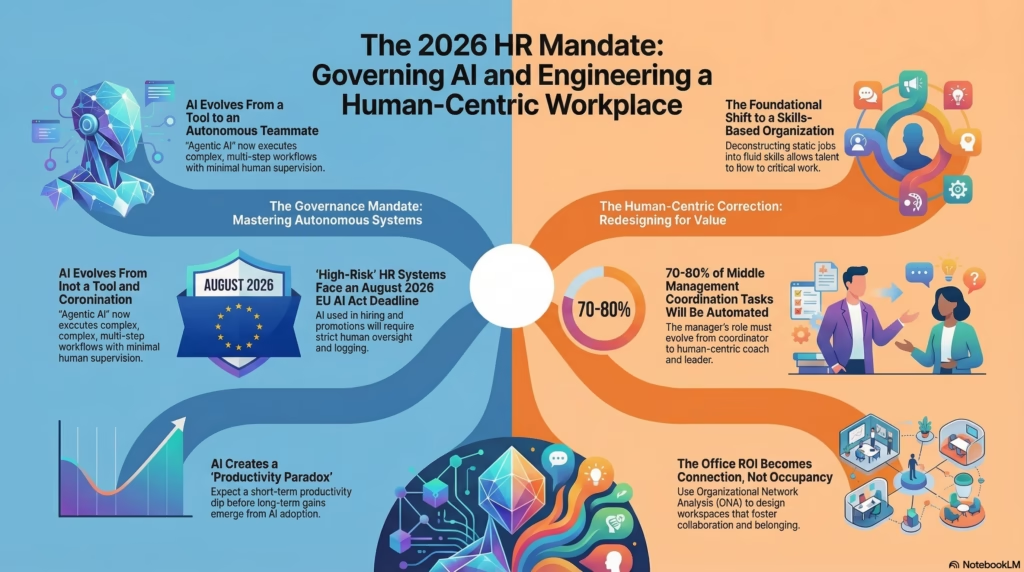
Compliance in the age of Agentic AI is not discretionary; it is time-bound and mandatory, particularly given the European Union’s regulatory stance. The EU AI Act carries extraterritorial reach and mandates stringent duties for high-risk systems.[10] Critically, the core high-risk system requirements begin taking effect in August 2026.[10, 11]
HR’s use of AI in processes such as recruiting, promotion, and performance evaluation will be classified as high-risk, triggering mandatory duties for worker notice, establishing human oversight, stringent logging procedures, and active monitoring for discrimination.[11] Organizations must prepare by February 2026, when guidance is expected to clarify which workplace and HR uses of AI qualify as high-risk.[11]
The transition to autonomous systems exposes the organization to a significant accountability vacuum. If an AI agent executes a workflow that results in discriminatory outcomes or error, the liability question arises: who is responsible? Accountability for Agentic AI impacts spans LLM creators, model adapters, deployers, and the organizational users.[9] The organizational governance framework must define the specific Accountable Leader (typically the CHRO or VP of HR) who takes ultimate responsibility for the agent’s impacts.[9] This governance must translate policy requirements into technical system constraints, such as constraining the agent’s action space, requiring human approval, and providing technical mechanisms for interruptibility (graceful shutdown capabilities).[9]
D. Prescriptive Framework: Implementing an AI Accountability and Oversight Policy
To manage these risks, organizations must adopt a formal framework that maps governance requirements directly to system components and executive roles.
AI Accountability and Oversight Framework (Table I)
| AI System Component | HR Accountability Role | Core Governance Action | Regulatory Alignment |
| Large Language Model (LLM) | Data & Model Vetting Team | Continuous Bias Auditing & Diverse Training Data [8] | GDPR, EEOC, EU AI Act High-Risk Monitoring [11] |
| Agentic Workflow Design | HR Process Owner | Constraining Action Space and Defining Human Interruptibility [9] | Safety and Performance Requirements |
| Automated Decision Output | Accountable Leader (CHRO/VP) | Providing Legibility/Explainability (Attribution of Action) [9] | Worker Notice and Logging Requirements [11] |
III. The Foundational Redesign: Building the Skills-Based Organization (SBO)
The fundamental shift in how work is defined—from static jobs to fluid skills and tasks—is a prerequisite for maximizing the value of both human and Agentic talent. However, the path to a skills-based organization (SBO) is paved with significant operational and technical debt.
A. The Erosion of the Job Description and the SBO Rationale
The traditional concept of the “job” and its static definition is increasingly viewed as the factor holding businesses back from success.[12] Organizations are moving to deconstruct jobs into underlying tasks and required skills, enabling talent to flow flexibly to the work.[12] This strategic approach, fueled by AI-driven disruption [13], allows companies to buffer talent shortages, future-proof their workforce, and quickly adapt to shifting market demands.[13] Furthermore, shifting the focus from credentials (degrees) to competencies allows organizations to screen in high-potential employees from non-traditional backgrounds, improving the quality of hires, and enhancing predictability and fairness in the selection process.[13, 14]
B. Technical Friction and Legacy Systems: The Operational Headache
The largest operational hurdle facing legacy organizations attempting to implement skills-based management at scale is technical debt. Most current HR information systems (HRIS, ERP) were architected around static job titles and roles, not dynamic skills [Query]. This misalignment creates a massive technical and operational headache.
For SBO initiatives to succeed, technology must be viewed purely as an enabler, not the starting point.[13] Any new AI tools or platforms (e.g., talent marketplaces) must be evaluated based on their ability to integrate or seamlessly connect with existing HR and workforce applications, including the company’s core HRIS and learning management systems.[13] The technical resistance to SBO is, at its core, a data migration and quality challenge, requiring decades of siloed, unrationalized skill definitions to be cleaned and unified.
C. The Skills Taxonomy Roadmap: Governance and Rationalization
A robust, governed skills taxonomy is the intellectual infrastructure of the SBO. Developing this taxonomy manually is often inconsistent, costly, and difficult to maintain long-term.[15]
A successful blueprint for large-scale skills transformation comes from organizations like SAP, which implemented a centralized, data-driven approach to skills governance.[16] They utilized Generative AI and similarity scoring derived from Large Language Models to rationalize a fragmented taxonomy, consolidating over 6,000 internal skills down to fewer than 2,000.[16]
This process mandates a hybrid approach, where AI-powered mapping enhances consistency, accuracy, and efficiency while retaining centralized governance workflows for quality control.[15] This tech-assisted method drastically reduces the manual labor of skills mapping and ensures the validated content can feed critical HR functions like talent acquisition, learning and development, and career pathing.[15, 17] Establishing a centralized program team, reporting to the Chief People Officer, is essential for ensuring alignment and gaining buy-in from complex stakeholder groups across the enterprise.[16]
D. Strategic HR (Skills-Based) Transformation Blueprint
The following blueprint outlines the necessary migration from traditional, role-centric processes to outcome-driven, skills-based architectures.
Strategic HR (Skills-Based) Transformation Blueprint (Table II)
| Traditional HR Process | Goal in SBO (2026) | HRIS Challenge | 2026 Solution/Tooling |
| Talent Acquisition (Credentials) | Assessment of Competencies & Potential | Systems built for static job codes [13] | AI-powered Skills Mapping and Assessment Tools [13, 14] |
| Annual Review (Role-Centric) | Continuous Feedback on Task Mastery | Difficulty tracking transferable skills [17] | Integrated Learning & Talent Marketplaces; Dynamic Skill Gap Analysis [15] |
| Manager Task Assignment | Deconstructed Work & Allocation | Lack of common skill vocabulary [17] | Governed, Rationalized Skills Taxonomy (The Hybrid Model) [15, 16] |
IV. Reskilling the Core: Transforming Middle Managers into Executive Coaches
The rise of Agentic AI creates a critical “middle management squeeze.” As coordination and reporting tasks become automated, the managerial role must pivot entirely to human-centric value creation, necessitating a massive reskilling effort within organizations.
A. The Unbundling of Management Tasks
Historically, the middle manager role combined two distinct functions: high-touch leadership (coaching, context, judgment) and high-volume coordination (reporting, updating trackers, checking statuses, routing tickets).[18] AI tools are absorbing the procedural coordination work, which is estimated to constitute 70–80% of a typical manager’s time.[18] The inevitable economic reality is that if the majority of tasks are automated, fewer pure coordinators will be required, flattening organizational structures and eliminating unnecessary overhead.[18]
B. The New Value Proposition: Manager as Coach and Empathy Carrier
The managers who survive this organizational flattening must demonstrate entirely new competencies. Their core value proposition shifts to providing nuanced judgment calls, translating strategy into human action, coaching employees through difficult situations, and building the essential relationships that machines cannot replicate.[18] These managers become crucial intermediaries, reinterpreting and supervising AI-driven tasks, while enabling their teams to focus on the higher-value, creative work.[19] They are positioned to discover how and where AI can best be used, thereby reducing employee anxiety and managing the change process.[19, 20]
C. Closing the Empathy Gap: Training and Curriculum
A critical challenge for HR is that current managers often lack the refined soft skills necessary for this coaching role. Many were promoted based on technical prowess rather than relational intelligence, leading to an “empathy gap” where leaders struggle to balance compassion with necessary accountability.[21]
HR must overhaul talent development and promotion criteria to prioritize coaching aptitude over technical expertise. Training programs must be revamped to provide a practical approach to developing empathy as a core leadership strength.[21] This includes modules focused on intentional communication (asking respectful questions to understand experience), emotional validation (stepping into others’ shoes), and thoughtful response (balancing relationships and results through clear, compassionate expectation setting).[21] Developing this human capability is essential for creating the trust and psychological safety needed for high performance and strong teams in the disruptive, agentic workplace.[21, 22]
V. The Post-Hybrid Strategy: Manufacturing Serendipity and Belonging
As remote and hybrid models mature, a new crisis of “digital atomization” demands a strategic response from HR that focuses on connection and belonging over mere productivity tracking.
A. Diagnosing Digital Atomization and the Loss of Serendipity
Employees are connected technologically but often report feeling lonely or atomized [Query]. A major concern among business leaders regarding hybrid and remote work is the resulting decline in spontaneous communication—the “watercooler moments” or “serendipity” that drive innovation and the cross-fertilization of ideas.[23] The data indicates that successful hybrid models cannot simply port over old, on-site management approaches; they require intentional collaboration strategies and empathy-based management to strengthen the connection to culture.[24]
B. Redefining the Office ROI: From Productivity Center to Connection Hub
The justification for maintaining physical office space in 2026 must be fundamentally redefined. The purpose of the office is no longer defined by the ability to perform work (which can happen anywhere) but by its capacity to manufacture serendipity and belonging [Query]. HR must drive the strategy to optimize the physical environment specifically as a hub for innovation and spontaneous social connection.[25]
C. Prescriptive Measurement: Utilizing Organizational Network Analysis (ONA)
To shift from measuring “occupancy rates” to “connection scores” [Query], HR must adopt advanced people analytics tools like Organizational Network Analysis (ONA). Traditional engagement surveys or static headcount metrics fail to capture the informal, vital connections that underpin collaboration and performance.[26]
ONA maps the underlying collaboration patterns within the organization.[26] It can identify critical network roles, such as knowledge hubs (who receives most requests for complex problem-solving) and brokers (who bridges communication between departmental silos).[27] Crucially, ONA also identifies isolates, individuals on the edges of networks who have very few social ties.[27] By quantifying the degree of isolation and network density, ONA provides a forward-looking retention predictor, allowing HR to proactively intervene with targeted mentorship or connection programs.[26, 27]
This data-driven approach allows HR to make strategic decisions regarding office optimization, ensuring the physical space maximizes utility for vital face-to-face interaction.[25] The ONA dataset also supports influence and inclusion analysis, revealing unconscious bias in networking patterns that may limit access to advancement opportunities for certain groups.[26]
D. The Shift in Hybrid Workforce Metrics
The strategic mandate requires replacing obsolete volume metrics with sophisticated network indicators.
The Shift in Hybrid Workforce Metrics (Table III)
| Traditional HR Metric | 2026 Human-Centric Metric (ONA) | Strategic Insight Provided |
| Office Occupancy Rate | Connection Scores / Network Density [27] | Actual value derived from physical presence and cultural integration [25] |
| Annual Engagement Survey | Identification of Network Isolates [26, 27] | Early warning for digital loneliness, exclusion, and attrition risk |
| Team Performance Rating | Identification of Knowledge Hubs / Brokers [27] | Critical points of information flow, potential single points of failure, and informal leadership structures |
| Manager Task Tracking | Cross-Functional Communication/Silo Mapping [27] | Gaps in collaboration; ability of teams to generate serendipitous innovation [23] |
VI. Global Workforce Complexity: Mitigating Legal Risk in the Fluid Workforce
The workforce of 2026 is increasingly heterogeneous, consisting of a blend of full-time employees, gig workers, fractional executives, and AI agents [Query]. Managing this blended workforce requires complex operational systems and rigorous legal compliance.
A. The Blended Workforce Reality and Cultural Equity
As organizations expand globally, the use of external talent is escalating, with some forecasts suggesting that the majority of new hires may be based outside a company’s home country.[28] This “open talent” approach demands creating a cohesive culture and equitable experience across all tiers of workers.[29]
The focus must shift from traditional perks to emphasizing autonomy, flexibility, and value alignment. HR must foster loyalty among gig and fractional workers by providing transparent feedback, offering development opportunities where feasible, and ensuring that every contribution is genuinely valued and celebrated.[29, 30] Onboarding and offboarding processes must be seamless and welcoming, integrating flexible workers without traditional hierarchical barriers.[29]
B. The Compliance Catastrophe: Analyzing Global Misclassification Risk
The most significant legal exposure associated with the fluid workforce is worker misclassification (mistaking a contractor for a legitimate employee, or vice versa).[28] This risk is amplified because the definitions of “employee” and “contractor” vary significantly across jurisdictions and are subject to frequent, rapid change.[28] Compliance failures, driven heavily by misclassification, are financially punishing, averaging $42,000 per incident globally.[28]
This compliance risk acts as a strategic impediment to international growth. Navigating multiple, evolving legal systems simultaneously exponentially increases exposure.[28] The landscape is tightening worldwide, evidenced by specific gig economy regulations such as Spain’s “Rider Law” and relevant UK Supreme Court rulings.[31]
C. The 2026 Compliance Imperative: Navigating Evolving Laws
Compliance infrastructure must be modernized to handle forthcoming legislative changes. For instance, in California, new employment laws are phasing in, including expanded jurisdiction for the Public Employment Relations Board effective January 1, 2026.[32] Furthermore, beginning January 1, 2027, the private sector must increase pay data reporting, forcing employers to classify employees across 23 job categories, rather than the previous 10, requiring finer analysis of pay disparities.[32, 33]
The rapid pace of legislative evolution demands that HR governance moves beyond manual oversight. The only scalable defense against global regulatory risk is the deployment of automated compliance monitoring systems.[28] This involves leveraging AI-powered tools to track legislative changes, set compliance alerts for HR leaders, and integrate unified payroll and benefits platforms that can execute real-time compliance checks across multiple operating jurisdictions.[28] This level of integration ensures consistency while respecting the nuanced requirements of local labor laws.[28]
VII. Proving ROI: Redefining Performance to Solve the Productivity Paradox
CEO demands for demonstrable ROI from massive technology investments, especially in AI, place the onus on HR to prove that the workforce is genuinely more productive, not merely busier [Query]. This requires abandoning outdated performance measures and adopting an outcome-centric philosophy.
A. The Productivity Paradox Analysis: Short-Term Losses
The observable phenomenon known as the “productivity paradox” reveals that massive investments in new technology do not immediately translate into measurable output gains. Research indicates that AI adoption tends to hinder productivity in the short term, with firms often experiencing a measurable decline initially.[34] These short-term losses precede long-term gains, mandating that HR manage executive expectations regarding the necessary transition time and investment required for value realization.[34] The goal must be to transition performance measurement away from assessing hours worked or tasks completed toward measuring the realization of business outcomes and measurable impact.[35]
B. The Pivot to Outcome-Based Performance
To demonstrate true business value, HR must adopt a framework that aligns individual and organizational effort directly with strategic priorities. This requires a shift in performance management philosophy. The traditional annual review, focused on subjective activity metrics, is insufficient for an agile, blended workforce.[6] Instead, performance must be anchored to demonstrable business results.
C. Framework Implementation: Utilizing Objectives and Key Results (OKRs)
Objectives and Key Results (OKRs) represent the most effective framework for measuring outcomes in the agentic workforce.[6] OKRs enforce a culture of accountability and excellence by providing clear direction and alignment across the organization, from individual contributors to top leadership.[6]
The use of OKRs directly addresses the productivity paradox by becoming the accountability mechanism for agentic workflows. When an AI agent assumes 70% of a job’s procedural tasks, measuring human activity is irrelevant. OKRs force the measurement to the final organizational result—for example, achieving a 25% increase in team productivity metrics or increasing utilization of a specific system by 20%.[36] This links the performance of the integrated human-agent workforce directly to measurable business acceleration, justifying the ROI of the technology investment.[35, 36]
Furthermore, OKRs support the necessary shift to continuous performance management (Conversations, Feedback, and Recognition—CFR), ensuring real-time monitoring and promoting ambitious yet realistic goals.[6] By embedding OKRs, HR elevates its role from administrative oversight to a strategic business partner focused on the quantifiable realization of enterprise value.[36]
VIII. Conclusion and Strategic Mandate
The 2026 HR landscape is defined by the inescapable duality of governance and human empowerment. Success will be determined not by the adoption of sophisticated technology, but by the maturity of the organizational frameworks used to govern that technology and maximize the uniquely human capabilities it cannot replicate. The strategy requires deep operational transformation in three primary areas: data architecture (skills), managerial capability (coaching), and compliance monitoring (legal exposure).
The CHRO’s strategic mandate for 2026 must focus on mitigating algorithmic risk while proactively investing in the human relationship network, ensuring that organizational growth is both accelerated by automation and protected by ethical boundaries.
Strategic Recommendations: The 2026 HR Leadership Checklist
| Strategic Challenge | Mandatory HR Action |
| Agentic AI & Governance | Implement a mandatory AI governance policy defining the Accountable Leader for autonomous agent impacts. Ensure systems provide legibility, interruptibility, and continuous bias auditing.[8, 9] |
| Wholesale Job Redesign | Launch a centralized data governance project to rationalize and unify the skills taxonomy, utilizing a tech-assisted hybrid approach.[15, 16] Initiate phased migration of core HRIS from job titles to skill clusters. |
| Middle Management Squeeze | Overhaul managerial development programs, shifting promotion criteria to prioritize coaching, empathy, and conflict resolution over technical expertise.[21] Embed AI change management into manager curricula. |
| Combating Digital Loneliness | Adopt Organizational Network Analysis (ONA) to quantify connection, identify network isolates, and measure cross-functional collaboration.[27] Redefine office use around “connection scores” rather than occupancy rates.[25] |
| Managing the Fluid Workforce | Deploy integrated, AI-powered systems for real-time compliance monitoring to track rapidly evolving global classification laws (contractor vs. employee).[28] |
| Solving the Productivity Paradox | Pivot performance management systems entirely to an Objectives and Key Results (OKR) framework to measure outcomes and impact, thereby quantifying the ROI of AI investments.[6, 35] |
——————————————————————————–
1. Gartner Identifies Four Trends Talent Management Leaders Should Prepare for in 2026, https://www.gartner.com/en/newsroom/press-releases/2025-10-29-gartner-identifies-four-trends-talent-management-leaders-should-prepare-for-in-2026
2. 3 top HR priorities for 2026, according to Gartner’s latest survey – HR Executive, https://hrexecutive.com/3-top-hr-priorities-for-2026-according-to-gartners-latest-survey/
3. Deloitte 2026 Technology, Media & Telecommunications Predictions – Press Release, https://www.deloitte.com/us/en/about/press-room/deloitte-2026-tmt-predictions.html
4. Three new AI breakthroughs shaping 2026: AI trends | Deloitte US, https://www.deloitte.com/us/en/what-we-do/capabilities/applied-artificial-intelligence/blogs/pulse-check-series-latest-ai-developments/new-ai-breakthroughs-ai-trends.html
5. Agentic AI in HR: Benefits, use cases and next steps – Zalaris, https://zalaris.com/consulting/resources/blog/understanding-agentic-ai-a-future-ready-guide-for-hr-leaders
6. OKR Based Performance Management system – Datalligence, https://datalligence.ai/blogs/okr-based-performance-management-system/
7. Getting HR Ready for Agentic AI: A Practical Guide for the Self-Automating Workforce, https://sea.peoplemattersglobal.com/article/ai-and-emerging-tech/getting-hr-ready-for-agentic-ai-a-practical-guide-for-the-self-automating-workforce-47303
8. Agentic AI in HR: Balancing Autonomy and Human Oversight – Phenom, https://www.phenom.com/blog/agentic-ai-in-hr
9. The evolving ethics and governance landscape of agentic AI – IBM, https://www.ibm.com/think/insights/ethics-governance-agentic-ai
11. Cybersecurity Awareness Month in Focus, Part III: The EU AI Act Is Here—What It Means for U.S. Employers – Ogletree, https://ogletree.com/insights-resources/blog-posts/cybersecurity-awareness-month-in-focus-part-iii-the-eu-ai-act-is-here-what-it-means-for-u-s-employers/
12. Skills based organisations: a new way to connect talent to work – Mercer, https://www.mercer.com/en-au/insights/talent-and-transformation/skill-based-talent-management/skills-based-organisations/
13. How Skills-Based Organizations Can Succeed | BCG, https://www.bcg.com/publications/2025/how-skills-based-organizations-can-succeed
14. Transforming HR: The Rise of Skills-Based Hiring and Retention Strategies – SHRM, https://www.shrm.org/labs/resources/transforming-hr-the-rise-of-skills-based-hiring-and-retention-strategies
15. Beyond “one size fits all”: How to create a sustainable skills taxonomy that is perfect for your organization – Mercer, https://www.mercer.com/en-us/insights/talent-and-transformation/skill-based-talent-management/how-to-create-a-sustainable-skills-taxonomy-that-is-perfect-for-your-organization/
16. Case Study Details – Reskilling Revolution – From Vision to Execution: How SAP Revolutionized Skills Governance, https://initiatives.weforum.org/reskilling-revolution/commitments/from-vision-to-execution:-how-sap-revolutionized-skills-governance%C2%A0/aJYTG0000000zhp4AA
17. The crucial role of a skills taxonomy for HR and L&D success | InStride, https://www.instride.com/insights/skills-taxonomy/
18. Leadership is the new management: how AI is unbundling middle management and what to do about it – Matt Hopkins, https://matthopkins.com/business/leadership-is-the-new-management/
19. Middle Managers Are Your Change Agents – Reworked, https://www.reworked.co/employee-experience/managers-arent-obsolete-theyre-underestimated/
20. 2026-Forecast.pdf – Workplace Intelligence, https://workplaceintelligence.com/wp-content/uploads/2025/10/2026-Forecast.pdf
21. Leading With Empathy Online Training Program – Blanchard, https://www.blanchard.com/our-content/programs/leading-with-empathy
22. Training for Managers | Human Resources – University of Texas at Austin, https://hr.utexas.edu/manager/training-managers
23. Hybrid And Remote Work And The Decline Of Serendipity In The Workplace – Forbes, https://www.forbes.com/sites/joemckendrick/2022/11/18/hybrid-and-remote-work-and-the-decline-of-serendipity-in-the-workplace/
24. Gartner Confirms Successful Hybrid Work Models Are Human-Centric, https://www.gartner.com/en/articles/think-hybrid-work-doesnt-work-the-data-disagrees
25. Unlock Team Dynamics with Organizational Network Analysis – Bizstim, https://www.bizstim.com/news/article/unlock-team-dynamics-with-organizational-network-analysis
26. Organizational Network Analysis: Complete Guide to Mapping Workplace Networks, https://teamspective.com/blog/2025/organizational-network-analysis-complete-guide-to-mapping-workplace-networks/
27. ONA Analysis: The unbeatable power of organizational networks – HR World, https://hrworld.org/ona-analysis-the-unbeatable-power-of-organizational-networks/
28. Global Hiring Compliance in 2026: Navigating International Labor Laws and Workforce Risk, https://ginitalent.com/global-hiring-compliance-in-2026-navigating-international-labor-laws-and-workforce-risk/
29. It’s Time We Had a Talk About the Gig Economy and Fractional Work, https://employerbranding.news/its-time-we-had-a-talk-about-the-gig-economy-and-fractional-work/
30. 5 Ways to Appreciate the Blended Workforce: Recognition for Gig and Full-Time Employees, https://www.advantageclub.ai/blog/blended-workforce-appreciation
31. Global guide: Independent contractors, potential misclassification issues, and labor implications – Hogan Lovells, https://www.hoganlovells.com/en/publications/global-guide-independent-contractors-potential-misclassification-issues-and-labor-implications
32. The Essentials—California Employment Law Update for 2026 | HUB – K&L Gates, https://www.klgates.com/The-EssentialsCalifornia-Employment-Law-Update-for-2026-11-17-2025
33. California Enacts New Employment Laws for 2026 | Insights – Mayer Brown, https://www.mayerbrown.com/en/insights/publications/2025/11/california-enacts-new-employment-laws-for-2026
34. The ‘productivity paradox’ of AI adoption in manufacturing firms – MIT Sloan, https://mitsloan.mit.edu/ideas-made-to-matter/productivity-paradox-ai-adoption-manufacturing-firms
35. The AI Productivity Paradox Research Report | Faros AI, https://www.faros.ai/blog/ai-software-engineering
36. 10 Performance Management OKR examples with initiatives – Tability, https://www.tability.io/templates/tags/performance-management