

New Tech, New Work: Redefining the Value Case for Technology Investment in the Modern Enterprise

Introduction: The Old Value Case Is No Longer Enough
The calculus of technology investment is broken. For decades, leaders relied on a simple formula of efficiency gains and cost reduction, where a new platform would automate a process, increase output, and yield a predictable return. The rise of augmentative AI has rendered that formula obsolete, creating a new imperative for value creation. Leaders now face both immense pressure to act and a sense of paralysis, caught between overwhelming options and the lingering disappointment of past investments that failed to deliver on their promise. Failing to invest now threatens to undermine outcomes across multiple dimensions, from human and business performance to brand and innovation.
This fundamental shift is clearly reflected in the 2025 Deloitte Global Human Capital Trends survey. Historically, the top drivers for technology investment were “enabling a workforce to do more, faster” and to “decrease cost.” Today, the most important drivers have evolved to a more human-centric and value-oriented focus: “enabling workers and machines to create value together,” “enabling the workforce to create new types of value,” and “improving worker well-being.” This transition signals that the conversation is no longer just about efficiency, but about empowerment and holistic success.
The purpose of this white paper is to provide a new framework for evaluating and justifying technology investments in this new era. The old value case, centered on simple inputs and outputs, is no longer sufficient. A new model must be adopted—one that captures not just process efficiencies but also technology’s broader impact on innovation, human performance, and holistic business outcomes.
To build this new value case, we must first understand the fundamental change in technology’s role within the enterprise, which has moved decisively from automation to augmentation.
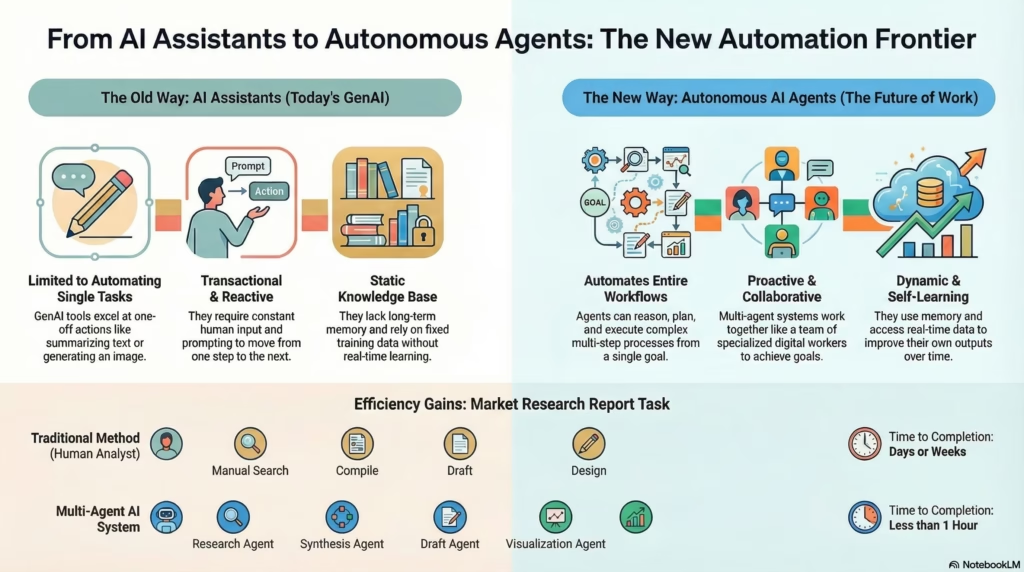
The Paradigm Shift: From Automation to Augmentation and Collaboration
Understanding the evolution of workplace technology is of paramount strategic importance. For years, the primary goal was automation—the substitution of human labor with machine processes. We are now entering a new paradigm: augmentation. This represents a strategic shift from replacing human tasks to magnifying human capabilities, creating a dynamic environment of human-machine collaboration that unlocks entirely new forms of value.
The traditional investment mindset, focused squarely on substitution, is critically limited. As MIT professor Daron Acemoglu estimates, only 5% of jobs are potential candidates for replacement by AI in the next 10 years. This suggests the real, transformative value lies not in eliminating human roles but in enhancing them. To navigate this landscape, leaders must distinguish between the tools that enhance daily tasks—the Work tech that drives productivity and collaboration—and the systems that cultivate the organization’s most valuable asset, its people—the Workforce tech for talent management and development. The new paradigm of augmentation blurs the lines between them, demanding a unified strategy.

AI agents represent the leading edge of this paradigm—a strategic shift from passive tools to active digital collaborators. Unlike typical language models that operate transactionally, AI agents are reasoning engines designed to understand context, plan workflows, connect to external tools, and execute actions to achieve a defined goal. They move beyond simple task execution to orchestrate entire processes.
| Dimension | Typical language models | AI agents |
| Use case scope | Automate tasks | Automate entire workflows/processes |
| Planning | Not capable of planning or orchestrating workflows | Create and execute multistep plans, adjusting actions based on real-time feedback |
| Memory & fine-tuning | Do not retain memory and have limited fine-tuning capabilities | Utilize short-term and long-term memory to learn from previous interactions and provide personalized responses |
| Tool integration | Not inherently designed to integrate with external tools or systems | Augment capabilities with APIs and tools (e.g., data extractors, search APIs) to perform tasks |
| Data integration | Rely on static knowledge with fixed training cutoff dates | Adjust dynamically to new information and real-time knowledge sources |
| Accuracy | Lack self-assessment capabilities; limited to probabilistic reasoning | Can leverage task-specific capabilities to validate and improve their own outputs and those of other agents |
This new paradigm of augmentation requires a fundamentally different way to measure value and govern investment, demanding a more holistic and forward-thinking framework.
A New Framework for Value: Three Pillars for Future-Ready Investment
To navigate the complexity of modern technology investments, leaders need a new toolkit. The core of this white paper is a three-pillar framework designed to help organizations build a robust value case that justifies investments beyond simple ROI and drives both human and business success. This framework moves beyond outdated metrics to embrace a more holistic, strategic, and collaborative approach to technology deployment.
Pillar 1: Redefining Metrics for Holistic Outcomes
One of the most significant hurdles organizations face is measuring the value of their technology investments. According to Deloitte’s Mapping digital transformation value report, 73% of executives identify the “inability to define metrics” as their number-one challenge. The old frames are too narrow, failing to capture the expansive ways that new technologies create value.
The solution lies in recognizing the mutually reinforcing cycle between business and human outcomes. Technology can create positive feedback loops where investments in people—their well-being, skills, and experience—cultivate greater value from the technology itself. This convergence empowers organizations to achieve goals beyond mere productivity.
A Fortune 100 food and beverage company provides a powerful example of a holistic business case built on this principle. To justify a new digital experience hub for its 300,000+ employees, the company moved beyond traditional measures to focus on three pillars:
- Faster: Give time back to workers to focus on value-added tasks. The company identified an opportunity to return 2 million hours to its workforce annually.
- Stronger: Reduce cost to serve and enhance organizational resilience and agility. This went beyond simple cost avoidance to include measures of “slack” for value-added work.
- Better: Improve the employee experience to drive business outcomes. The value case explicitly linked improvements in worker metrics like employee net promoter scores (eNPS) and retention to tangible business results, including customer satisfaction and profit.
To build a similar holistic case, organizations must look beyond traditional operational KPIs. Workforce Metrics like internal talent mobility and employee innovation are no longer ‘soft’ benefits; they are lead indicators of an organization’s capacity to adapt. Similarly, Purpose Metrics such as organizational trust and resilience directly quantify the cultural foundation required for technology to succeed, turning abstract goals into measurable strategic assets.
Workforce Metrics
- Employee retention
- Employee development
- Employee engagement/satisfaction
- Number of agile pods or teams
- Tolerance for experimentation and intelligent failure
- Internal talent mobility
- Employee innovation
- Employee utilization rate
- Employee productivity
Purpose Metrics
- Social return on investment
- Human sustainability
- Organizational trust
- Organizational resilience
- Organizational mission fit
- Corporate reputation
Defining these new metrics is the critical first step. The next is to adopt an investment approach that can pursue these less predictable, but higher-potential, outcomes.
Pillar 2: Adopting a Portfolio-Based Approach
For next-generation technologies with probabilistic payoffs, the traditional model of investing in a single tool for a predictable ROI is inadequate. Instead, organizations should adopt an R&D-style portfolio approach. The goal is not for every investment to succeed, but for the successful bets in the portfolio to more than cover the ones that do not pan out.
Consider a company aiming to accelerate new product development. Rather than making a single large investment, it could assemble a portfolio of related technologies:
- Generalized AI tools for engineers and designers to spark ideation.
- New virtual modeling software to enable rapid prototyping.
- Smart manufacturing tools, like industrial robots, to speed time to market.
While any one of these investments might not achieve the full desired outcome on its own, their combined effect could produce transformative results. This portfolio model is the only practical way to pursue the holistic human and purpose-driven outcomes previously outlined, as single-threaded ROI calculations cannot capture the synergistic value of these complex, interdependent investments.
A portfolio approach is more appropriate than a traditional one when certain characteristics are present:
- The complexity of measuring value is high.
- Realizing value depends on other complementary organizational changes or investments.
- The time horizon for payback is unclear or long-term.
- The uncertainty of outcomes is significant.
- The technology’s impact is spread across multiple functions rather than a single process.
Managing a diverse portfolio of strategic bets effectively requires a more inclusive and dynamic governance model.
Pillar 3: Implementing Cross-Functional and User-Centric Governance
A siloed approach to value creation is a relic of the past. The new value case must be co-created across a fused ecosystem of stakeholders, including HR, IT, finance, business unit leaders, and, crucially, the workers who will use the technology. This collaborative approach ensures that investments align with diverse needs and that the organization is prepared for the changes required to realize the technology’s full potential.
The risks of poor governance are stark. Research from the 2025 Global Human Capital Trends survey reveals that the “number-one reason workforce technology investments have failed to meet their investment case is ‘lack of workforce skills/capabilities’.” This highlights the critical need to involve workers and plan for upskilling from the very beginning.
Two leading companies exemplify effective, cross-functional governance:
- Salesforce: When deploying AI-powered agents to support employees, Salesforce democratized their creation. Instead of a top-down IT-driven process, business leaders are empowered to identify use cases and deploy “digital workers” to solve specific problems. As Ruth Hickin, vice president of workforce innovation, states, “We have a really democratized process for creating agents… any function can deploy them.”
- Johnson & Johnson: The company created a cross-functional HR Decision Science team, bringing together experts and specialists from across the organization. The team is tasked with tapping the organization’s vast data resources to make better end-to-end workforce-related decisions, improve organizational and worker outcomes, and drive science-based and data-driven people decisions across all talent practices.
With redefined metrics, a portfolio-based approach, and collaborative governance, organizations can build a robust and future-ready foundation for technology investment. The next step is to see how this framework applies to the advanced technologies transforming the enterprise today.
The New Value Case in Action: AI Agents Transforming the Enterprise
This section provides concrete examples of how AI agents and multiagent systems are already delivering on the promise of the new value case. A multiagent AI system is a transformative approach where multiple, role-specific AI agents collaborate to orchestrate and automate complex workflows. By decomposing a process into multiple tasks and assigning them to specialized agents, these systems can produce higher quality, faster, and more trustworthy outcomes than a single agent could achieve alone.
Multiagent AI systems offer several key benefits that unlock significant value for the enterprise:
- Capability: Agents can automate interactions with multiple tools (e.g., browsing a website, performing quantitative calculations) to perform tasks that standalone models cannot.
- Productivity: Agents can plan and execute complex workflows from a single prompt, significantly accelerating the path from request to delivery.
- Self-learning: By tapping short- and long-term contextual memory, agents can rapidly improve their output quality over time.
- Adaptability: As needs change, agents can reason and plan new approaches, reference new data sources, and engage with other agents to coordinate execution.
- Accuracy: “Validator” agents can be employed to interact with “creator” agents, automatically testing and improving the quality and reliability of outputs.
- Intelligence: Specialized agents, each applying its own memory and reasoning capabilities, can collaborate to achieve new levels of machine-powered intelligence.
- Transparency: These systems can showcase how agents communicate and reason together, providing a clearer view of the collective decision-making process.
The following use cases illustrate how these benefits translate into tangible business impact.
Use Case: Talent Acquisition and Recruitment
Traditional recruitment is often bogged down by manual resume screening and repetitive administrative work. AI agents can automate the end-to-end recruitment process, from using natural language processing to analyze resumes and assess candidates to conducting initial screening interviews via AI-powered avatars.
- Increased efficiency: Automating repetitive tasks allows HR teams to focus on more strategic activities, shortening the time to hire.
- Improved candidate matching: By analyzing a broader range of data points, agents can match candidates to roles more accurately, improving the quality of hires.
- Reduced bias: By standardizing assessments and focusing on skills and experience, AI agents can help address unconscious bias in the recruitment process.
Use Case: Personalized Customer Support
Traditional customer support often relies on scripted interactions that fail to resolve complex inquiries. In contrast, multiagent AI systems can understand plain-language requests and generate natural responses that consider customer history, preferences, and real-time context. They can handle a wide range of complex inquiries, reducing the need for escalation to human agents.
- Greater consistency and scalability: AI agents can operate 24/7 without fatigue, maintaining a consistent quality of service regardless of inquiry volume.
- Compounding efficiencies: The ability to learn from each interaction helps reduce response times and frees up human agents to focus on more nuanced requests.
- Improved customer experiences: Each interaction can be adjusted to individual needs, improving satisfaction and engagement.
These real-world applications demonstrate the tangible, holistic value that can be unlocked when organizations adopt the right strategic framework for their technology investments.
Conclusion: Charting Your Course in the New Era of Work
The role of technology in the modern enterprise has fundamentally shifted. The paradigm has moved from simple automation to sophisticated augmentation, rendering traditional ROI models based on efficiency and cost-cutting insufficient. To thrive, organizations must adopt a new value case for technology—one that measures success through a holistic lens of human and business outcomes. This white paper has outlined a three-pillar framework for building that value case: redefining metrics to be holistic, adopting a portfolio-based approach to investment, and implementing cross-functional, user-centric governance.
The central theme is clear: technology’s promise is fundamentally unlocked by its human users. By focusing on augmenting capabilities and improving the worker experience, organizations can create a virtuous cycle of human and technological progress. This new approach empowers people to create greater value with technology, which in turn drives better business performance.
To begin this journey, HR and IT leaders should take immediate, concrete steps.
Blueprint for Action: Five Steps to Master the New Value Case
- Assess and prioritize use cases. Begin with a comprehensive assessment of current operations to identify high-impact areas where AI agents can add tangible value. Focus on processes ripe for automation or those involving complex decision-making to achieve quick wins.
- Develop a strategic AI agent road map. Create a detailed road map that aligns AI initiatives with broader business objectives. This plan should include clear milestones, timelines, and success metrics to guide the deployment of AI-powered capabilities across the organization.
- Invest in infrastructure and human talent development. Build the necessary infrastructure to support AI agents, including scalable cloud platforms and robust cybersecurity. Simultaneously, invest in upskilling your workforce, focusing on both technical skills and the ability to collaborate effectively with AI systems.
- Implement strong data governance and risk management. Establish strong governance frameworks to manage the risks associated with AI. Implement policies that ensure data integrity, security, and ethical use, while continuously monitoring AI interactions to safeguard against biases and unintended consequences.
- Nurture a culture of innovation. Empower your teams to experiment and explore new applications of generative AI. By embedding continuous learning and innovation into the fabric of your organization, you can maintain a competitive edge in a rapidly changing environment.
The future of the enterprise will not be defined by the technology it buys, but by the human potential it unlocks. By adopting this new value case, you are not merely making an investment; you are charting the course for a more innovative, resilient, and fundamentally human-powered organization.
- New Tech, New Work: Redefining the Value Case for Technology Investment in the Modern Enterprise
- Top 10 McDonald’s Interview Questions (and How to Answer Them)
- No Degree Required: How IBM’s “New Collar” Jobs are Changing Tech Hiring
- Adapt or Perish: How Accenture Reskills Its Workforce for the AI Era
- The Ultimate Roadmap: How to Get Hired at Google as a Fresher