

Adapt or Perish: How Accenture Reskills Its Workforce for the AI Era

Let’s be honest for a second: the headlines about Artificial Intelligence are terrifying. One day you read that AI will cure all diseases, and the next you read that it’s coming for your job, your creativity, and possibly your lunch.
In the corporate world, the mantra has shifted from “innovate or die” to something much more visceral: adapt or perish. But here is the good news – if you are working for the right company, “adapting” doesn’t mean frantically learning Python at 3:00 AM on a Sunday. It means being part of a systematic, massive investment in human potential.
Enter Accenture. While many tech giants are scrambling to figure out how AI fits into their products, Accenture is rewriting the playbook on how AI fits into its people. We aren’t just talking about a few PowerPoint slides and a mandatory webinar. We are talking about a multi-billion dollar bet that the future of work isn’t about replacing humans – it’s about supercharging them.
If you are a job seeker who values Learning and Development (L&D), or a professional wondering if your skills have an expiration date, you need to understand exactly what Accenture reskills is doing. It is arguably the most ambitious workforce reskilling experiment in the world right now.
The $3 Billion Statement of Intent
Money talks, right? In the world of corporate strategy, budget allocation is the only truth detector that matters. When Accenture announced a staggering $3 billion investment over three years specifically dedicated to its Data & AI practice, the industry paused.
But here is the detail that matters to you as a potential employee: a huge chunk of that money wasn’t for servers or software licenses. It was for people.
Accenture committed to doubling its AI talent to 80,000 people. But they aren’t just going out and hiring 40,000 new data scientists (mostly because 40,000 unemployed data scientists don’t actually exist). Instead, they are looking inward. They are betting that a marketing manager, a supply chain expert, or a classic management consultant can be transformed into an AI-savvy powerhouse.
This is the difference between a company that views labor as a cost and a company that views talent as a renewable resource. At Accenture, reskilling isn’t a remedial class; it’s the primary engine of business growth.
TQ: Your New IQ
If you join Accenture, one of the first acronyms you will learn is TQ. No, it’s not a typo for IQ or EQ. It stands for Technology Quotient.
Think about it. We generally accept that you need a certain level of intelligence (IQ) to solve problems, and emotional intelligence (EQ) to lead teams. But in 2025, if you don’t understand the fundamentals of cloud computing, agile methodologies, and generative AI, you are effectively illiterate in the language of business.
Accenture launched TQ as a mandatory learning program for everyone. And I do mean everyone. From the fresh graduate in the mailroom to the Managing Directors in the boardroom. The goal isn’t to turn everyone into a coder, but to ensure everyone speaks the language.
- The Basics: Understanding what the cloud actually is (beyond “someone else’s computer”).
- The Application: How blockchain might disrupt a supply chain.
- The Future: How Generative AI changes content creation.
This levels the playing field. It means that when you walk into a meeting at Accenture, you don’t have to feel “tech-shamed” if you come from a liberal arts background. The company provides the scaffolding to get you up to speed. It creates a culture where “I don’t know” is followed immediately by “but I can check the TQ module on that.”
Democratizing Generative AI: No PhD Required
When ChatGPT and other Large Language Models (LLMs) exploded onto the scene, many companies panicked. They banned the tools or restricted them to a tiny elite group of engineers.
Accenture did the opposite. They rolled out “GenAI for Everyone.”
This is a massive internal training initiative designed to demystify generative AI. Why? Because Accenture realizes that the best person to figure out how AI can improve HR is an HR professional, not a software engineer. The best person to apply AI to legal contracts is a lawyer, not a data scientist.
By putting these powerful tools—and the training to use them responsibly—into the hands of the entire workforce, Accenture is crowdsourcing innovation.
“We aren’t just teaching people how to write a prompt. We are teaching them how to deconstruct their jobs, identify the drudgery, and automate it away so they can focus on the strategy.”
— A Senior Accenture L&D Lead
The Learning Ecosystem: More Than Just Videos
We have all suffered through terrible corporate training. The click-through slides, the cheesy stock photos, the quiz at the end that you can pass by guessing. That is not what reskilling looks like at the high-tech frontier.
Accenture’s approach to L&D is immersive. Here is a peek inside their toolkit:
1. The Metaverse and VR
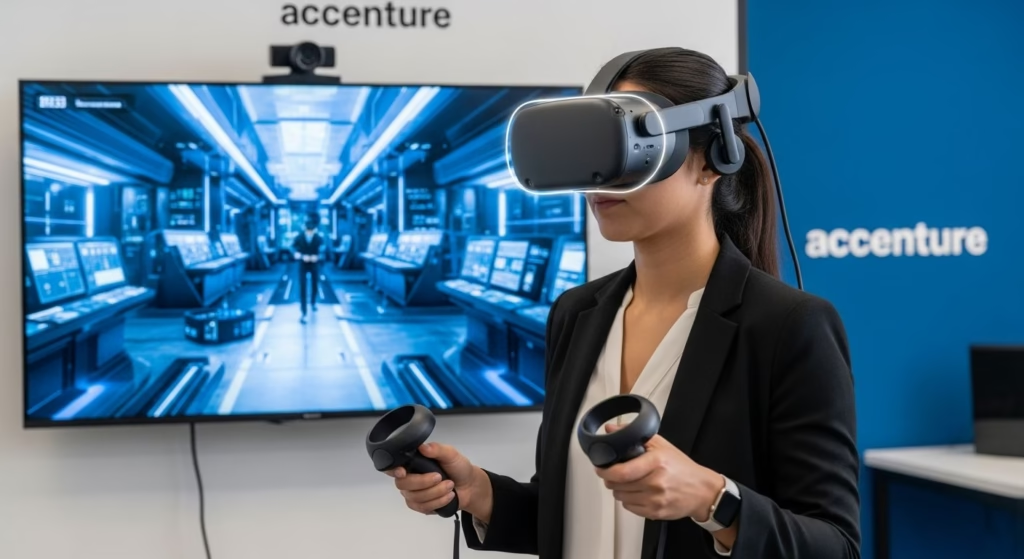
Yes, the Metaverse had a bit of a hype bubble burst, but for training? It’s alive and well at Accenture. They have onboarded hundreds of thousands of employees using Virtual Reality headsets. Imagine learning how to inspect a manufacturing plant without leaving your living room, or practicing a difficult client negotiation with a realistic avatar before you face the real thing.
2. Connected Learning Centers
While digital is great, humans still learn from humans. Accenture maintains physical hubs globally where employees dive deep into boot camps. It’s a university campus vibe, but everyone is getting paid to be there.
3. Gamification and Micro-learning
Nobody has 4 hours to watch a lecture. Accenture breaks down complex AI concepts into bite-sized “nuggets” that you can consume on your phone between meetings. They use gamification—points, badges, leaderboards—to tap into that competitive spirit.
From “Job for Life” to “Career for Life”
The old social contract of employment was: “You do this specific job for 30 years, and we pay you.” That is dead. The new contract, exemplified by Accenture, is: “You keep learning, and we keep finding new ways for you to add value.”
This is crucial for candidates to understand. When you apply to Accenture, you aren’t just applying for the role listed on the job description. You are applying for the role you will have in two years, and five years.
This fluidity is enabled by their internal talent marketplace. Once you upskill—say, you get certified in Salesforce or earn a badge in Responsible AI—you become visible to project leads across the globe who need that skill. You aren’t stuck in your silo. Your new skills are your passport to move around the massive organization.
Conquering the “Imposter Syndrome”
One of the biggest barriers to AI adoption isn’t technical; it’s psychological. Employees fear that if they try to learn AI and fail, they will look incompetent. Or they feel that “I’m a creative person, math isn’t for me.”
Accenture’s training programs are designed with a heavy emphasis on psychological safety. They frame reskilling as a journey, not a test. By emphasizing “Net Better Off”—a framework that looks at the holistic well-being of the employee—they ensure that learning feels like an investment in you, not a demand from you.
Why This Matters for Your Application
So, you are convinced. You want to work at a place that spends billions to make sure your brain doesn’t go obsolete. How do you leverage this in your interview?
- Show Curiosity, Not Just Capability: When they ask about your weaknesses, mention a technical gap but immediately pivot to how eager you are to close it using their resources.
- Ask About TQ: In the “Do you have any questions for us?” section, ask: “I’ve read about the TQ program. How has it helped your team specifically?” This shows you’ve done your homework.
- Highlight Adaptability: Share stories where you had to learn a new tool from scratch quickly. Accenture values the ability to learn (velocity) over what you already know (inventory).
The Verdict: A Safe Harbor in the AI Storm
The job market is volatile. Skills that were premium five years ago are commodities today. In this environment, the safest place to be is not the company that promises nothing will change—it’s the company that is best at managing change.
Accenture’s approach to reskilling is a signal. It signals that they believe the human element is the premium differentiator in the AI era. They aren’t building a factory of robots; they are building an army of augmented humans.
If you are ready to stop worrying about the future and start building it, looking into a career at Accenture might just be the smartest move you make. Adapt or perish? At Accenture, the motto is more like: Learn and Thrive.
Are you ready to boost your TQ? Check out open roles and see how your career can evolve.