

A Tuesday at Google: Why Our Offices Are Buzzing Again
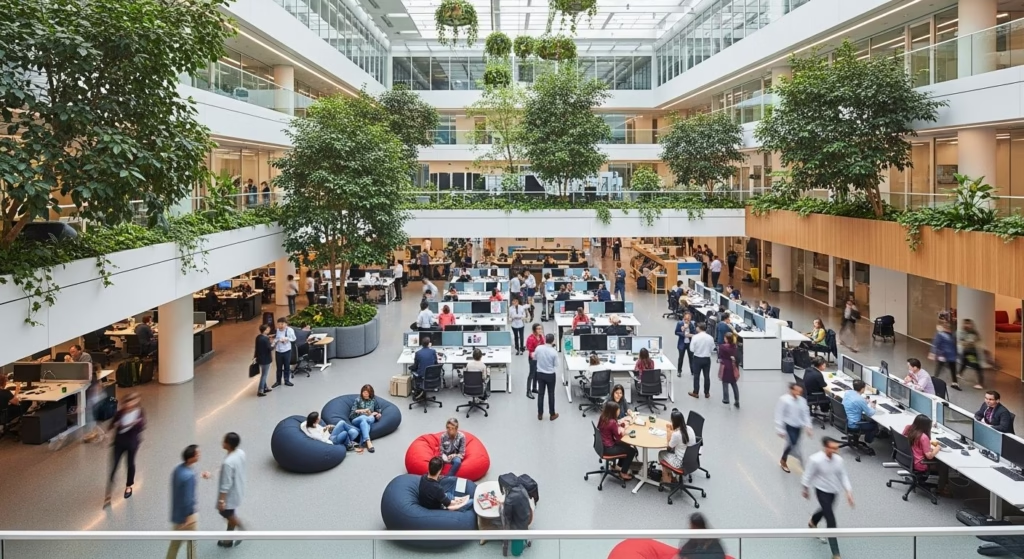
If you walked through the sliding glass doors of a Google campus three years ago, the silence was almost heavy. The colorful bikes stood in perfect, untouched rows. The micro-kitchens, usually the site of boisterous debates over espresso blends or API structures, were ghostly quiet. But if you walk into that same lobby today – specifically on a Tuesday – you’ll hear something that no high-speed fiber connection can replicate.
You hear the hum. The buzz. The distinct, chaotic, and energizing sound of Google office culture coming back to life.
It’s 9:00 AM, and the lobby in Mountain View (and Dublin, and Hyderabad) doesn’t feel like a corporate entryway; it feels like a transit hub for ideas. People are high-fiving over a launched feature. A product manager is drawing a diagram in the air while walking to the elevator with an engineer. The barista line is long, but nobody seems to mind because that’s where the weekend catch-ups happen.
This isn’t an accident. And it isn’t just because of a policy mandate. It’s the result of a fundamental shift in how we view the workplace. In this deep dive, we’re going to pull back the curtain on the “Anchor Day” phenomenon, explore why Google office culture is thriving in a hybrid world, and explain why your career growth might just depend on being part of the Tuesday buzz.
1. The “Anchor Day” Phenomenon: Why Tuesday is the New Friday
Let’s address the elephant in the room: Hybrid work is hard. When we first moved to a hybrid work model, many Googlers faced the “Ghost Town Effect.” You’d commute 45 minutes, badge in, and realize your entire team decided to work from home that day. You’d spend eight hours on video calls in a phone booth, eat a salad alone, and drive home. That wasn’t efficient, and it certainly wasn’t fun.
Enter the “Anchor Day.”
Organically, teams started gravitating toward Tuesdays (and often Thursdays) as their synchronization point. Tuesday has become the day where Google office culture hits its peak density. It is the day everyone commits to being there, not just to show face, but to create “critical mass.”
Why does density matter? Because Google office culture relies on collisions. If you fill a building with 10% of its capacity, it feels like a library. If you fill it to 80%, it feels like a festival. On Tuesdays, the energy is palpable. The whiteboard markers run dry faster. The laughter in the cafeteria is louder. This density turns the office from a “place to type on a laptop” into a “place to solve problems together.”
2. Scheduled Serendipity: The Innovation Engine
There is a concept we talk about a lot here: “Scheduled Serendipity.” It sounds like an oxymoron, right? You can’t schedule a breakthrough. But you can schedule the conditions for one.
In a fully remote environment, interactions are transactional. You schedule a 30-minute meeting to discuss Project A. You discuss Project A. You hang up. It’s efficient, but it’s sterile. You miss the margins—the five minutes before the meeting starts and the ten minutes after it ends. That is where Google office culture lives.
We recently surveyed a group of Senior Staff Engineers about their most impactful technical decisions of the last year. A staggering number of them traced the root of those decisions back to informal interactions:
- “I ran into a researcher from the DeepMind team while waiting for a shuttle.”
- “I overheard a debate at the table next to me in the café and realized they were solving the same latency issue we were.”
- “I saw a sketch on a whiteboard in the hallway and stopped to ask who drew it.”
This is why the offices are buzzing. Googlers are realizing that while they can code from anywhere, they can only “collide” here. The buzz is the sound of silos breaking down. In our evolving Google office culture, we encourage teams to clear their calendars of solitary work on Tuesdays. Save the report writing for your work-from-home Wednesday. Use Tuesday for the messy, unstructured, beautiful chaos of brainstorming.
3. Mentorship in 3D: Why Juniors Need the Buzz
One of the biggest risks of a remote-first world is the erosion of apprenticeship. You can teach someone to code via a screen share. It is much harder to teach them “judgment” or “influence” or “navigating ambiguity” over a video call.
Junior engineers and new hires (our beloved “Nooglers”) absorb Google office culture through osmosis. They learn by watching a VP handle a tense moment in a meeting. They learn by swiveling their chair around to ask a “stupid question” that they would be too afraid to type into a formal Slack channel/Chat.
The buzz in the office is the sound of knowledge transfer. Senior leaders are returning to the office in droves because they recognize their responsibility to the culture. They know that their physical presence signals accessibility. When a Director sits in the open micro-kitchen rather than a closed office, it invites connection.
For those early in their careers, the message is clear: If you want to accelerate your growth, go to where the buzz is. Being physically present on high-traffic days like Tuesday puts you in the flow of information. It makes you visible. In a massive organization, visibility is a currency.
4. The Micro-Kitchen: More Than Just Free Snacks
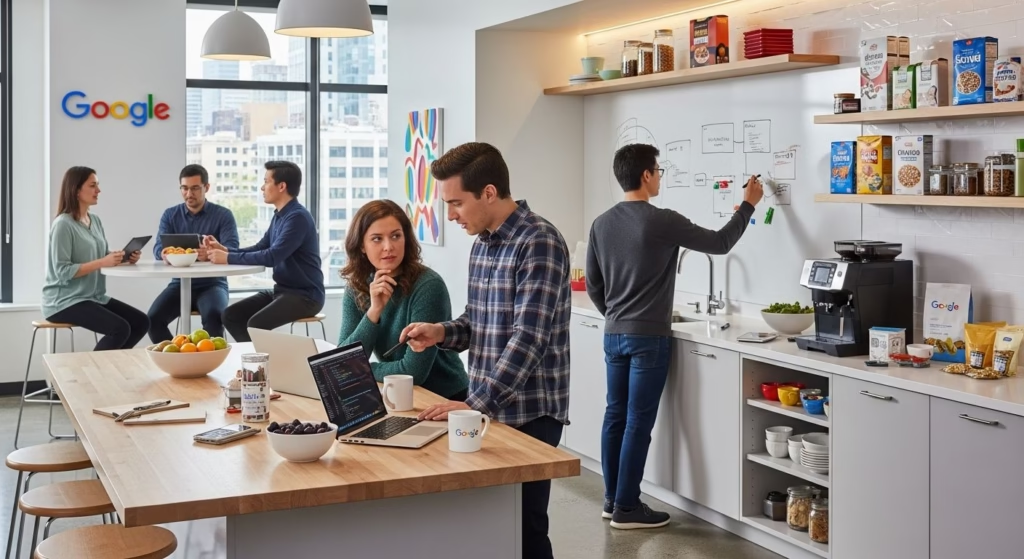
It’s easy to dismiss the famous Google food perks as just that—perks. But in the context of Google office culture, the micro-kitchen (MK) is a strategic tool. It is a collision zone.
In 2025, we’ve redesigned many of our MKs to be even more social. We’ve moved away from “grab and go” layouts to “stay and chat” designs. Why? Because the data showed us that the longer people linger, the more cross-functional barriers break down. The buzzing sound you hear near the sparkling water tap? That’s usually a Marketing Lead and a Backend Engineer figuring out why a user flow isn’t converting.
If you were at home, you’d walk to your fridge, grab a yogurt, and sit back down alone. The MK forces you to interact. It forces a reset of your cognitive load. It reminds you that you are part of a larger organism. This communal breaking of bread is ancient, and it remains the glue of Google office culture.
5. The “Commute-Worthy” Standard
We aren’t blind to the reality of logistics. The commute is real. Traffic on the 101 or the M25 hasn’t magically disappeared. For the buzz to be sustainable, the destination has to be worth the journey. We call this the “Commute-Worthy Standard.”
If you come into the office just to put on noise-canceling headphones and attend video calls all day, we have failed you. That is a waste of time and gas. To support the hybrid work model, we have shifted our event programming.
On Tuesdays, our campuses come alive with:
- Tech Talks Live: Watching a Principal Engineer diagram a complex distributed system on a whiteboard in real-time is visceral. You can feel the room react. You can raise your hand.
- Team Lunches: We prioritize budget for team meals on Anchor Days. It’s not just about calories; it’s about connection without an agenda.
- Demo Days: Teams set up monitors in common areas to show off what they built the previous week. It’s like a science fair for adults, and it generates immense pride.
The buzz isn’t just noise; it’s the sound of value being generated that cannot be generated digitally. It’s the sound of people realizing that while they can work from anywhere, they belong here.
6. Psychological Safety and the “Warmth” of the Room
Psychological safety is the bedrock of high-performing teams (shout out to Project Aristotle). Interestingly, we’ve found that building trust is faster in person. Google office culture thrives on the ability to read the room.
It’s easier to read body language, to see a smile behind the eyes, to sense when someone is hesitating and needs encouragement. In a buzzing office, you see the humanity of your colleagues. You see them spill coffee. You see them laugh at a bad dad joke. You see them frustrated.
This shared humanity builds a reservoir of goodwill that makes the remote days smoother. When you know the person behind the avatar, you are less likely to misinterpret a terse email or a delayed chat response. The buzz of the office is the sound of trust being refilled.
7. Navigating the Noise: A Guide for Introverts
Now, a word for the introverts (and many of us at Google are introverts). A “buzzing” office can sound exhausting. Does Google office culture now demand constant extroversion? Absolutely not.
The beauty of our campus design is zoning. The buzz is contained to the collaboration districts—the cafes, the team pods, the hallways. But we have fiercely protected our “Library Zones” and “Focus Booths.” The most successful Googlers in this new era are masters of “environment switching.”
They might spend the morning in the thick of the buzz, doing design reviews and stand-ups. Then, they retreat to a silent library zone for two hours of deep coding. They use the campus as a tool, navigating between high-energy collaboration and deep-focus isolation. The office supports both; the buzz just makes the collaboration time more potent.
Conclusion: The Office is a Tool, Not a Trap
So, why are our offices buzzing again? Because we stopped viewing the office as a container for employees and started viewing it as a tool for empowerment. We stopped asking “How do we make people come back?” and started asking “What can happen here that can’t happen anywhere else?”
The answer is connection.
Google office culture isn’t about ping-pong tables or sleeping pods (though we still have those). It’s about the people. It’s about the incredibly high density of talent, curiosity, and kindness that exists within these walls. When you stay home every day, you are voluntarily cutting yourself off from the greatest resource Google has to offer: other Googlers.
The buzz is the sound of potential. It is the sound of curiosity. It is the sound of a thousand micro-problems being solved over coffee.
If you are looking at your career and wondering how to get to the next level, or if you are a candidate looking at Google from the outside, know this: The hybrid work model is here to stay, but the office is not a relic. It is the engine room. Come for the free lunch? Sure. But stay for the conversation that changes your career trajectory. That’s why we’re here on a Tuesday. And judging by the noise level in the lobby right now, we aren’t the only ones.
FAQ: Life at Google & Hybrid Work
What is the current Google office culture regarding hybrid work?
Google currently follows a hybrid work model for most roles, typically expecting employees to be in the office about three days a week. We view these days as opportunities for collaboration, connection, and community building, rather than just attendance.
Are Anchor Days mandatory at Google?
Anchor Days (like Tuesdays) are generally team-decided rather than company-mandated. Teams choose specific days to coordinate their schedules to ensure maximum overlap, creating a ‘buzzing’ atmosphere that facilitates collaboration.
How does Google support deep work in a buzzing office?
While collaboration areas are lively, Google campuses are designed with ‘zoning.’ We have designated quiet libraries, focus booths, and nooks specifically for deep, uninterrupted work, allowing employees to switch environments based on their tasks.
Is food still free at Google offices?
Yes! Our cafes and micro-kitchens provide free, healthy, and diverse food options. We view shared meals not just as a perk, but as a vital part of Google office culture that encourages cross-functional interaction and socialization.
Does coming to the office actually help my career at Google?
While performance is measured by impact, being in the office facilitates mentorship, visibility, and ‘serendipitous’ networking. Engaging with the community in person often leads to faster learning and new opportunities, especially for those early in their careers.